Tag: health inequalities

  • Woodlands in urban areas linked to reduced antidepressant use

    Improving and maintaining woodlands in deprived communities is linked with reduced antidepressant and anti-anxiety medication use, new joint research from the OPENspace research centre and CRESH suggests.

    People living in deprived communities are less likely to use medication for depression and anxiety if they have easy access to well-maintained woodlands, the study found.

    Researchers at the Universities of Edinburgh and Glasgow analysed data from more than 129,000 people over five years.

    The study is one of the largest analyses of its kind, assessing how investments in local woodlands in and around towns in Scotland affect people’s mental health.

    The researchers used NHS prescription records and census data to see whether people living within a 10-minute walk of an improved woodland area were more or less likely to be taking medication for depression or anxiety.

    Woodland improvements had been supported through Scottish Forestry’s Woods In and Around Towns (WIAT) initiative, which provided funding for practical improvements such as new footpaths, better signage, and community events.

    The initiative prioritised areas that were more socially and financially disadvantaged, where woodlands required improved management to reduce barriers and enable more local people to use and enjoy them.

    People living in urban deprived communities that were close to a woodland area that had been made more welcoming and easier for people to use were 10 per cent less likely to be prescribed antidepressants and six per cent less like to be prescribed anti-anxiety medication, than those living further away.

    This was the case even when accounting for other factors linked to mental health outcomes, such as demographics and poverty.

    The benefit of living near these woodlands showed up for the same people even when their proximity to these woodlands changed. For example, when someone moved closer to an improved woodland, their need for medication went down.

    By tracking the same individuals over time, the researchers say they can be more confident that it was the woodland improvements making the difference, rather than simply healthier or wealthier people happening to live in greener areas.

    Professor Catharine Ward Thompson of the OPENspace Research Centre at the University of Edinburgh’s College of Art, who led the study, said “The research provides stronger evidence on the mental health benefits of woodland improvements for local communities than was possible in earlier studies. It also shows that these benefits may contribute to reducing inequalities in health across the population.”

    Dr Scott Ogletree, of the OPENspace Research Centre at the University of Edinburgh’s College of Art, who undertook the analysis, said: “For the first time, we have an opportunity to link data on mental health services with a long-term national urban forestry intervention programme to offer the kind of evidence required to inform future forestry policy.

    Our results tell us that relatively modest investments in local greenspaces can make a real difference to people’s mental health. Nature focused initiatives like WIAT can be a valuable tool to complement ongoing efforts to improve wellbeing and mental health.”

    Around one in eight people globally live with a mental health condition, and those in poorer communities tend to be hit hardest. At the same time, these are often the communities with the least access to good quality parks, woodlands, and greenspaces.

    The researchers say that their findings make a case for integrating nature-based interventions into public health strategies, particularly in urban areas where greenspace can be limited and poorly maintained in certain neighbourhoods.

    The research team have worked with experts from Scottish Forestry and Forest Research for over 20 years to gather evidence on the social and health benefits that local woodlands can offer to communities, pioneering work on this topic within Europe.

    Minister for Agriculture, Marine and the Islands Jim Fairlie, said: “This groundbreaking study provides further compelling evidence of the benefits that local woodlands deliver for people and communities. The association between the investment in woods in and around Scotland’s towns and cities, and lower prescription use for depression, and anxiety highlights the importance of continuing to expand, manage and improve these valuable green spaces.

    “The Scottish Government is committed to increasing woodland creation across Scotland, with a target of 18,000 hectares per year by 2029/30. We are also committed to increase tree planting in urban areas to improve air quality, support biodiversity and enhance quality of life for communities across the country.”

    The research used census data from the Scottish Longitudinal Study which tracks the lives and health of thousands of people in Scotland to help researchers understand what affects people’s wellbeing.

    The study is published in The Lancet Planetary Health. The paper is available here: https://www.thelancet.com/journals/lanplh/article/PIIS2542-5196(26)00076-8/fulltext DOI – 10.1016/ j.lanplh.2026.101503.

    The research was supported by the Economic and Social Research Council (ESRC) and the GroundsWell Consortium, a UK-wide research partnership funded by the UK Prevention Research Partnership (UKPRP), that studies how green and blue spaces, can improve health and reduce health inequalities.

  • Recession, austerity and health

    We recently developed a project summary for an ESRC-funded study looking at the impact of the financial crisis and subsequent austerity measures on mental health and wellbeing in the UK. The summary for the CRESH project (full title: Recession, austerity and health: changing area socio-economic conditions and their relationship to individual health and wellbeing outcomes in Scotland) includes the key findings, links to papers published, details of some of the dissemination activities, and other useful resources. You can read more in the pdf below:

  • Being a Scout or Guide protects mental health and narrows inequalities in later life

    By Rich Mitchell and Chris Dibben

    beaver-scouts-plant-trees-for-their-gardener-badge-pic-credit-the-scout-association
    Today, with colleagues from the Longitudinal Studies Centre Scotland at Edinburgh University, we have published a study
    which found that being in the Guides or Scouts as a child seems to protect your mental health long into adulthood. Those who were in the Guides or Scouts were about 18% less likely to have a mood or anxiety disorder at age 50, than those who were not. This protective link seems especially strong for children who grew up in less advantaged households, so much so that the usual ‘gap’ in mental health between those from richer and poorer backgrounds does not exist among those who were Scouts or Guides. (more…)

  • Regions of Europe gaining migrants have lower death rates

    By Helena Tunstall

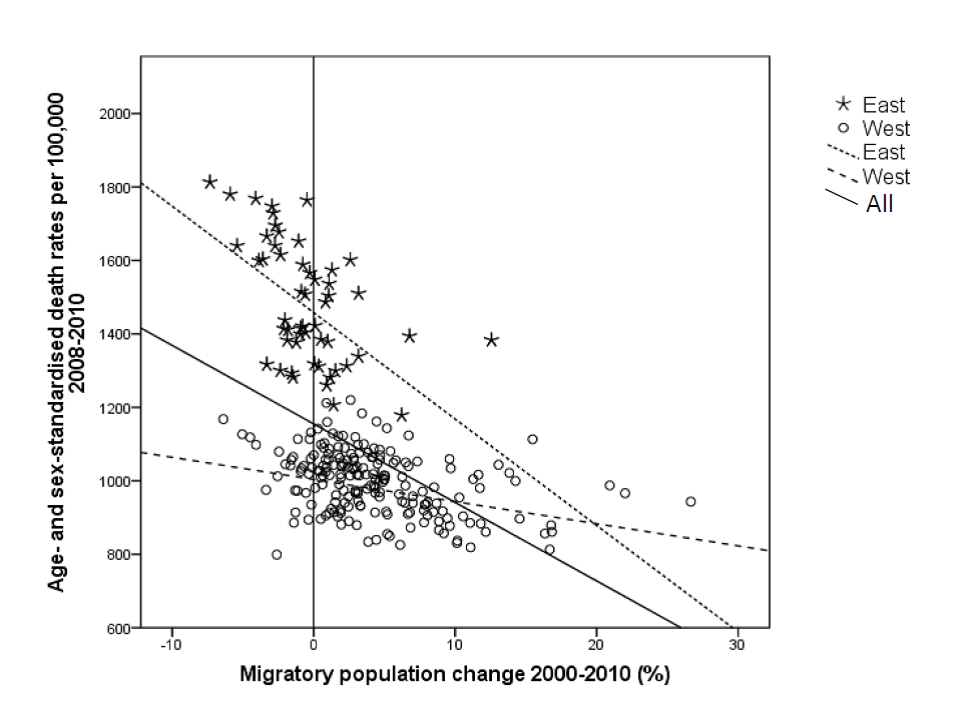
    New research just published by CRESH in the European Journal of Public Health suggests there is a strong correlation between net migration, 2000-2010, and age- and sex- standardised death rates, 2008-2010 among the regions of Europe (Figure 1). The recent ‘migrant crisis’ in Europe has ensured that European political debate about migration, long centred on immigration, has continued to focus upon areas receiving migrants. This analysis suggests however that difficulties associated with immigration are the problems of advantage. Regions of Europe which experienced significant population growth through migration, were found mostly in Western countries with higher incomes and lower death rates. In contrast, Europe regions with net out-migration, predominantly located in the East, are burdened by the combined problems of low incomes, high death rates and population decline.

    EJPH_scatterplot_blog
    Figure 1 Death rates and migration among European regions


    (more…)

  • Financial distress and inequalities in wellbeing across 13 European countries

    Financial distress and inequalities in wellbeing across 13 European countries

    By Claire Niedzwiedz

    Governments are increasingly recognising the wellbeing of their citizens as a policy priority.  But in times of economic difficulty the welfare ‘safety net’ is often reduced, which may adversely affect the wellbeing of those most threatened by financial insecurities. Focusing on social inequalities in wellbeing across different countries – as we do in our latest paper – is therefore crucial.

    By alf.melin, Flickr. Creative Commons (CC BY-SA 2.0) (more…)

  • Alcohol and Health in Scotland: Key Stats

    As MSPs meet in the Scottish Parliament today to debate progress made against Scotland’s Alcohol Strategy, we’re launching a timely infographic to highlight the very real dangers of the oversupply of alcohol in our society, and the knock-on implications for health and inequality. Final Infographic

    (more…)

  • How difficult life events influence risk of mental health problems and moves to deprived neighbourhoods

    We’ve just published a journal article that assesses the links between difficult life events, residential moves and spatial inequalities in mental health in the UK.

    Repossession2We find that people that move following difficult life events, such as relationship breakdown and eviction, have poor mental health and distinctive patterns of mobility.

    Difficult life events appear to both harm mental health and residential opportunities, increasing the likelihood that people with poor mental health will live in socio-economically deprived neighbourhoods. Moves related to difficult life events could reinforce socioeconomic inequalities in health between areas by concentrating people with poor health in disadvantaged areas.

    (more…)

  • Mapping life expectancy in Scottish Parliamentary Constituencies

    By Helena Tunstall, Elizabeth Richardson & Jamie Pearce

    New life expectancy at birth figures for 2011-2013 for Scottish Parliamentary Constituencies have just been released by National Records of Scotland (NRS). We’ve mapped and graphed these data to illustrate the latest geographical patterns of mortality in Scotland. (more…)

  • ‘An environment where young people choose not to smoke’ is not one where tobacco products are sold on every street corner

    By Niamh Shortt

    Teenagers are more likely to smoke if they live in areas with the highest number of tobacco retailers. Our paper led by Niamh Shortt, published today in Tobacco Control, examined the relationship between tobacco outlet density and smoking habits of 13 and 15 year olds in Scotland.   (more…)

  • Social differences in pollution across the EU may help to explain health inequalities

    As a European Commission report and an important academic paper have recently reminded us, air pollution remains a persistent threat to population health across Europe. Pollutants such as particulate matter and ozone are among the leading causes of premature mortality and respiratory-related health outcomes. Globally, exposure to air pollution ranks as one of the top ten risk factors for health. (more…)
