Category: News

  • A Quarter of the Population Isn’t Visiting Green Spaces – why does that matter and what can you do about it? 

    Ask most people whether green spaces are good for health and you’ll get a fairly confident “yes”. The evidence backs them up. Time spent in parks, woods, gardens, coasts and waterways is linked to lower stress, better mental health, more physical activity, and greater social connection. For people experiencing health problems and even other disadvantages, that connection with nature may be especially powerful. Green spaces potentially act as a health equaliser in communities where access to other health-supporting resources is limited.

    So, here’s the question those of us who evangelise about the health benefits of green spaces don’t ask nearly often enough: who isn’t going?

    Around a quarter of the UK population visits green or blue spaces less than once a month. In Scotland, NatureScot surveys put that figure at roughly 26%. Research across 33 European cities found comparable numbers. These aren’t people who lack green spaces nearby. Many of them live within walking distance of a park. Yet for a complex web of reasons, some visible, some much harder to see, they simply don’t go. 
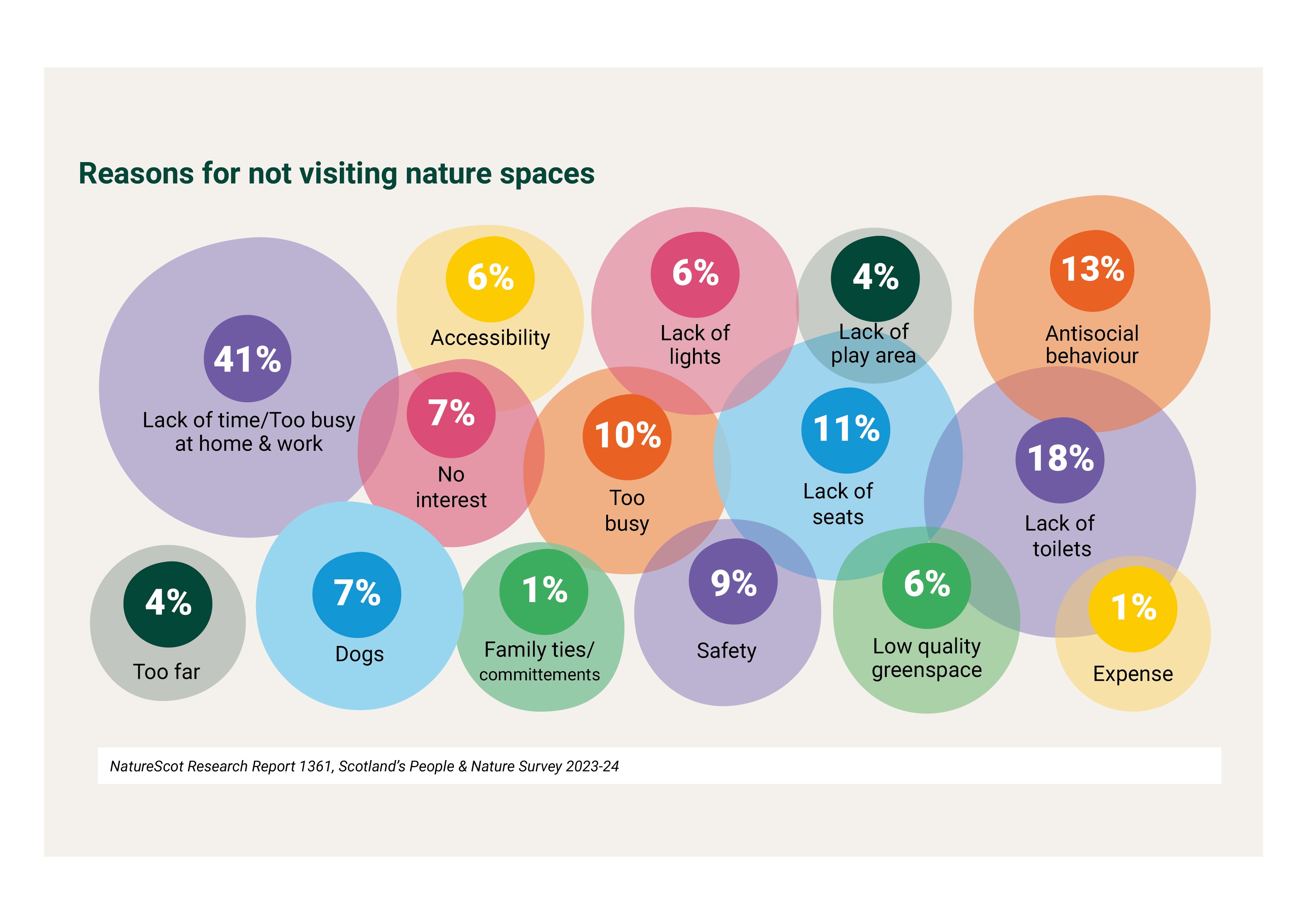
    Graphic quantifying reasons for not visiting nature spaces

    This is what we call the ‘green gap’ and it matters enormously, because the people least likely to visit green spaces are disproportionately the same people who stand to benefit most from them: those with long-term health conditions, people from lower socioeconomic backgrounds, older adults, people with disabilities, and people from minority ethnic groups. In other words, the very populations for whom a regular walk in the park could make the biggest difference are the ones researchers, policy makers and practitioners have consistently failed to reach.

    Until now, research and policy have had no coherent framework for thinking about why.

    Introducing the Green Gap Framework

    Published in Landscape and Urban Planning, the Green Gap Framework is the first theoretical framework designed specifically to map and explain non and low use of urban greenspaces. Developed by members of CRESH, Rob Bushby, and the GroundsWell consortium, the framework is the product of an extensive iterative process involving literature review, expert consultation, and collaboration with over 100 researchers, policymakers, planners, practitioners, and members of the public across the UK, Europe, and beyond.

    What the framework offers is something deceptively simple but genuinely novel: a shared language and a structured way of thinking about all the reasons someone might not visit a green space. Not just the obvious ones. The framework organises these reasons across four interconnected domains.
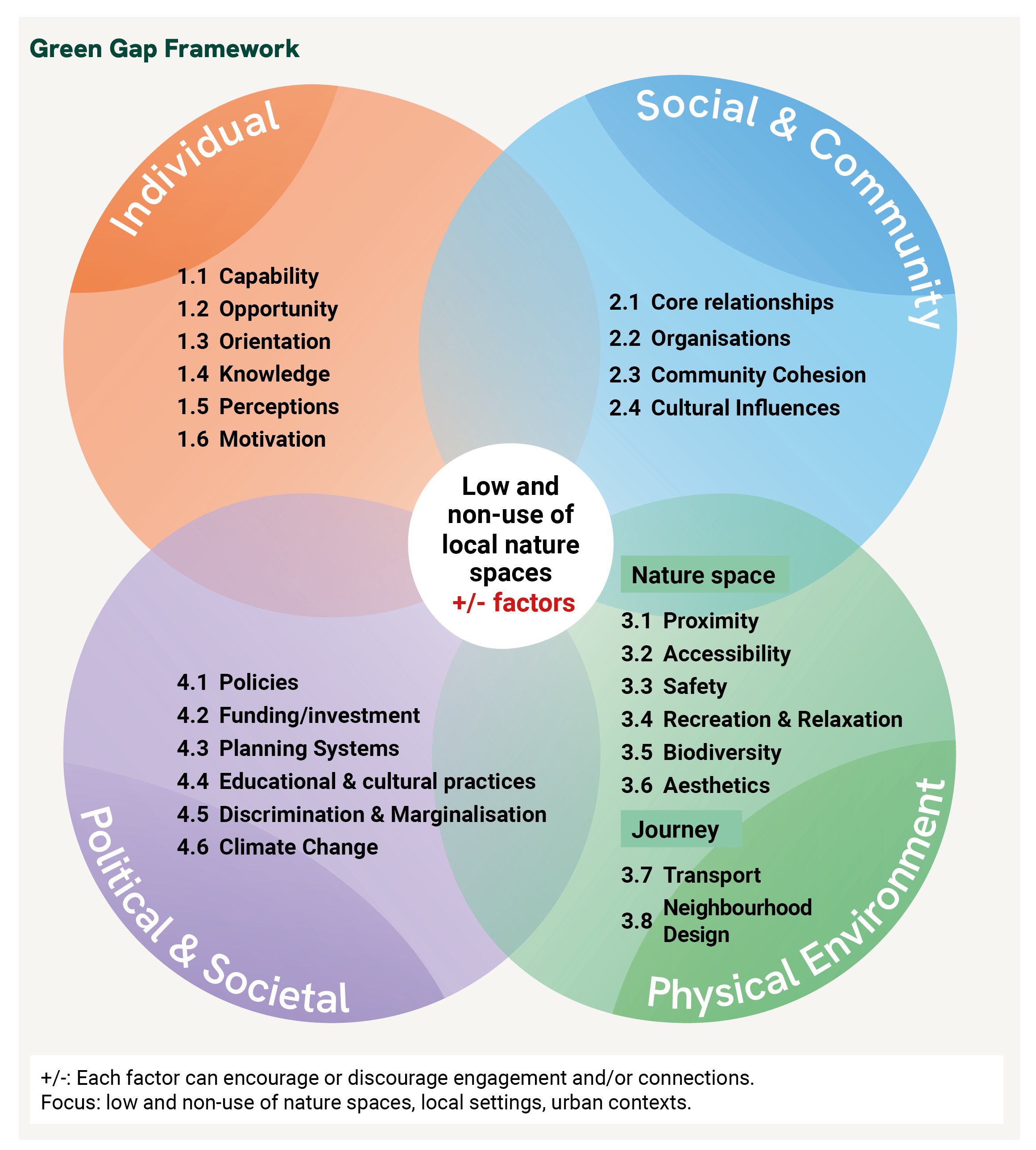
    Domain 1 – Individual. This covers the factors unique to a person: their physical and mental capability to visit, the time and opportunity they have, their knowledge of what’s nearby, their attitudes and prior experiences, and  – crucially – their motivation or lack of it. 

    Domain 2 – Social and Community. Whether or not someone visits a green space is also shaped by the people and groups around them; family members and friends who model or discourage outdoor habits, community organisations, schools and employers, the cohesion and perceived safety of a neighbourhood, and the cultural significance (or absence) of green spaces in someone’s background.

    Domain 3 – Physical Environment. This is where most existing policy and research has focused; the characteristics of green spaces themselves (proximity, accessibility, safety, aesthetics, biodiversity, facilities for recreation) as well as the journey to get there (transport links, neighbourhood design, roads and infrastructure). These factors matter enormously, but they’re not the whole story.

    Domain 4 – Political and Societal. Perhaps the most overlooked domain: the policies, funding decisions, planning systems and cultural practices that shape which communities have well-maintained, welcoming green spaces and which do not. This domain also considers discrimination and marginalisation, and the impacts of climate change.

    Each factor in the framework is marked with a +/− symbol to reflect an important insight: the same factor that enables one person to use a green space may be the very thing that prevents another. Dogs in a park are a draw for some visitors and a deterrent for others. A park that feels safely secluded to one person may feel isolated and threatening to another.

    What Makes This Different?

    Previous greenspace research has tended to ask, ‘what are the benefits of green spaces, and how do we design better ones?’ Those are valuable questions, but they assume the barrier is primarily a physical one; if you build it well enough, people will come.

    The Green Gap Framework challenges that assumption directly because interventions that focus only on physical improvements risk missing the deeper drivers of non-use and, at worst, can actively worsen inequalities.

    The framework also makes a deliberate and important methodological choice. Earlier drafts organised barriers around demographic categories: age, sex, ethnicity, disability. These were replaced with attitudinal and trait-based factors. The reason is significant: the framework’s purpose is not to predict in advance which groups won’t visit green spaces, but to explain why any group or individual might not, and to identify where intervention could help. This shift makes it far more useful across different communities and contexts.

    A Tool Built for Use and Change

    The framework was explicitly designed to be used beyond academia. We worked throughout its development with planners, park managers, third-sector organisations, and members of the public to ensure it would be genuinely applicable in the real world.

    The framework is designed to evolve. We have been very clear that this is not a finished product. Like the influential frameworks by Markevych et al. and Lachowycz and Jones that have shaped greenspace and health research, the Green Gap Framework is intended as a living tool, refined as empirical evidence accumulates and as different communities engage with it.

    The Bigger Picture

    Health inequalities are widening. The populations most affected by poor health are also those with the least access to the things that protect and restore health, including green space. At a time when public health budgets are under severe pressure, the case for low-cost, scalable interventions that can reach the people who need them most is urgent.

    Green and blue spaces are, in principle, free to access. They exist in or near most urban communities. They have a robust and growing evidence base for physical and mental health benefits. The problem is not the spaces themselves. The problem is the complex, multilevel web of barriers, individual, social, environmental, and systemic, which prevent too many people from using them.

    The Green Gap Framework doesn’t solve that problem, but it gives us, for the first time, a coherent way to think about it and a shared foundation from which researchers, planners, policymakers and practitioners can begin to work on it together.

    Find out more

    We have more information and assets for you, including a plain-language summary guide for practitioners and policy makers.

    The Green Gap Framework paper is published open access in Landscape and Urban Planning: https://doi.org/10.1016/j.landurbplan.2026.105663

    More resources, insights and use cases are available on the Green Gap section of the Groundswell website.

    GroundsWell is funded by the UK Prevention Research Partnership (MR/V049704/1).
  • CRESH web mapper down

    We’re sorry that the web mapper is currently offline. Please bear with us whilst it’s fixed. We hope to have it back up at the start of April.

  • Job Opportunity: Green space quality

    We have a post available at the MRC/CSO Social and Public Health Sciences Unit in Glasgow, working on our project measuring green space quality, and looking at its association with health. It’s very cool.

    Apply here: https://my.corehr.com/pls/uogrecruit/erq_jobspec_version_4.jobspec?p_id=049068

    Closing Date: 8th March 2021

    Funding is approved on a full-time basis (35 hours) until 1st May 2023.

    As a successful candidate you will contribute to the project `Better Parks, Healthier for All?. This project will make a systematic, longitudinal assessment of associations between a range of green space qualities, and risk factors for/measures of cardiometabolic disease and poor mental health. This is a joint UK-Australia project, led in the UK by Prof Rich Mitchell and in Australia by Prof Xiaoqi Feng. Whilst the state and third sectors in both countries have blueprints for what to capture in measuring green space qualities, there are no spatially comprehensive validated secondary measures of quality available. This post is particularly focused on the co-production of measures of urban green space qualities for 4 cities in Scotland and Australia, using secondary map data, remote imagery including Google Earth and Lidar, and secondary crowd-sourced biodiversity measures.

    The successful candidate will also be expected to contribute to the formulation and submission of research publications and research proposals as well as help manage and direct this complex and challenging project as opportunities allow.

    Main Duties and Responsibilities

    1. Implement the access, analysis and interpretation of secondary spatial and satellite imagery data that will underpin an assessment of green space quality.
    2. Contribute to the creation and use of the green space quality measures and analysis of their association with measures of health cardiometabolic and mental health.
    3. Document research output including analysis and interpretation of all data, maintaining records and databases, drafting technical/progress reports and papers as appropriate.
    4. Establish and maintain your research profile and reputation and that of The University of Glasgow/ School/ Research Group, including establishing and sustaining a track record of independent and joint publications of international quality in high profile/quality refereed journals, enhancing the research impact in terms of economic/societal benefit, and gathering indicators of esteem.
    5. Contribute to surveying the research literature and environment, understanding the research challenges associated with the project & subject area, & developing/implementing a suitable research strategy.
    6. Present work at international and national conferences, at internal and external seminars, colloquia and workshops to develop and enhance our research profile.
    7. Contribute to the identification of potential funding sources and to assist in the development of proposals to secure funding from internal and external bodies to support future research.
    8. Contribute to developing and maintaining collaborations with colleagues in Australia, and across the research group/School/College/University and wider community (e.g. Academic and Industrial Partners).
    9. Contribute to programme / Unit meetings/seminars/workshops and Institute research activities to enhance the wider knowledge, outputs and culture of the Unit and Institute.
    10. Perform administrative tasks related to the activities of the Programme
    11. Keep up to date with current knowledge and recent advances in the field/discipline.
    12. Engage in personal, professional and career development, to enhance both specialist and transferable skills in accordance with desired career trajectory.
    13. Carry out modest teaching / supervision activities if and when requested by the Programme Leader.
    14. Undertake any other reasonable duties as required by the Programme Leader or Unit Director
    15. Contribute to the enhancement of the University¿s international profile in line with the University¿s Strategic Plan, Inspiring People Changing The World.

    For appointment at Grade 7:

    1. Perform the above duties with a higher degree of independence, leadership and responsibility, particularly in relation to planning, funding, collaborating and publishing research and mentoring colleagues.
    2. Establish and sustain a track record of independence and joint published research to establish and maintain your expert reputation in subject area.
    3. Survey the research literature and environment, understand the research challenges associated with the project & subject area, & develop/implement a suitable research strategy.

    Qualifications

    Essential
    A1. Scottish Credit and Qualification Framework level 10 (Honours degree) in a relevant subject or a cognate discipline, or equivalent

    For grade 7:
    A2 Normally Scottish Credit and Qualification Framework level 12 (PhD) or alternatively the equivalent in professional qualifications and experience, with experience of personal development in a similar or related role(s)

    Desirable:
    B1 An awarded (or recently submitted or near completion) PhD in subject specialism or equivalent

    Knowledge, Skills & Experience

    Knowledge & Skills

    Essential
    C1. A comprehensive and up to date knowledge of GIS (ArcGIS or QGIS) / spatial analysis as applicable to the relationships between environment and health.
    C2. Management & handling of big and/or spatial data, including parallel and/or automated processing techniques
    C3 Excellent communication skills (oral and written), including public presentations and ability to communicate complex date/concepts clearly and concisely.
    C4 Expertise in the access and use of satellite &/or aerial imagery for analysis of landscape features and content.
    C5 Excellent interpersonal skills including team working and a collegiate approach
    C6 Ability to search and synthesise literature from different disciplines.
    C7 Self-motivation, initiative and independent thought/working
    C8 Commitment to open research, through open data, open code, open educational resources, and practices that support replication.
    C9 Problem solving skills including a flexible and pragmatic approach

    For appointment at grade 7
    C10 Ability to lead the design and implementation of spatial analysis of relationships between environment and health
    C11 Ability to lead the drafting, revision, and submission of academic research articles.
    C12 Sufficient depth of relevant research experience, normally including sufficient postdoctoral experience in a related field, appropriate to an early career researcher

    Desirable
    D1. Knowledge of the impacts of urban natural environments on human health
    D2 Knowledge of urban analytics, &/or spatial ecology, &/or applied human/physical geography
    D3 Knowledge of the use of biomarkers and clinical measurements of cardiovascular / cardiometabolic health
    D4 Programming (ideally R or Python) or platforms (e.g., Google Earth Engine) for spatial data handling and analysis

    Essential

    Experience
    E1 Sufficient relevant research experience [or equivalent] appropriate to an early career researcher
    E2. Experience of running stakeholder workshops or similar
    E3. Experience of scientific writing
    E4. Proven ability to deliver quality outputs in a timely and efficient manner
    E5. Evidence of an emerging track record of publications in a relevant field

    For appointment at grade 7
    E6. Proven ability to deliver quality outputs in a timely and efficient manner
    E7. A strong track record of presentation and publication of research results in quality journals/conferences
    E8. Experience of making a leading contribution in academic activities
    E9. Ability to demonstrate a degree of independence as illustrated by identification of project objectives from assessment of the literature, design & analysis of experiments & drafting of papers.
    E10. Experience in undertaking independent research

    Desirable
    F1. Experience of collaborative working across disciplines.
    F2. Experience of using cardiovascular / cardiometabolic health indicators

    Standard Terms & Conditions:

    Salary will be on the University’s Research and Teaching Grade, 6/7 £29,176 – £32,817/£35,845 – £40,322 per annum.

    Funding is approved on a full-time basis (35 hours) until 1st May 2023.

    New entrants to the University will be required to serve a probationary period of 6 months.

    The successful applicant will be eligible to join the Universities’ Superannuation Scheme. Further information regarding the scheme is available from the Superannuation Officer, who is also prepared to advise on questions relating to the transfer of Superannuation benefits.

    All research and related activities, including grants, donations, clinical trials, contract research, consultancy and commercialisation are required to be managed through the University¿s relevant processes (e.g. contractual and financial), in accordance with the University Court’s policies.

    It is the University of Glasgow’s mission to foster an inclusive climate, which ensures equality in our working, learning, research and teaching environment.

    We strongly endorse the principles of Athena SWAN, including a supportive and flexible working environment, with commitment from all levels of the organisation in promoting gender equality.

    The University of Glasgow, charity number SC004401.

    Vacancy Ref : 049068, Closing date : 8 March 2021.

  • New journal: Wellbeing, Space & Society

    CRESH co-Director Jamie Pearce who is co-editing a new journal focused on the role of place in understanding human health and wellbeing along with Susan Elliott who is a Professor at the University of Waterloo, Canada.The journal, named Wellbeing, Space & Society, is an interdisciplinary journal concerned with the difference that space, place and location make to wellbeing. It welcomes submissions that are theoretically informed, empirically supported, of interest to an international readership, address a problem of interest to society, and illustrate the links (potential or theorized) between (aspects of) society and space and wellbeing. We publish papers from a range of social science disciplines – geography, sociology, social psychology, social epidemiology, economics, anthropology, political science, amongst others.

    The editors are particularly interested in the policy implications of the research, including work informed by policy analysis. Methodological plurality and innovation are encouraged; interpretation of wellbeing in this context may be subjective or objective, eudonic or hedonic, and may also be at the individual and/or community levels. But they are particularly interested in the wellbeing of places – how is that conceptualized, theorized, operationalised and translated?

    For more information please contact Jamie Pearce

  • An atlas of change in Scotland’s built environment 2016-17

    By Laura Macdonald from the MRC/CSO  Social and Public Health Sciences Unit, University of Glasgow @theSPHSU

    Our neighbourhood environments change and evolve often; some changes are minor, while others involve major transformation. Change can take various forms; green space created or removed, existing housing or amenities demolished, new housing estates built, new motorways created, or existing transport infrastructure modified or extended. Change may affect neighbourhood residents’ physical or mental health, or health-related behaviours, to their benefit or to their detriment. To study how change in our neighbourhoods might affect our health we need robust information but data showing how our neighbourhoods are changing, at a fine geographic scale, for the whole of Scotland, did not exist – until now! This is why we created an atlas showing what’s changed, and an interactive mapping application which allows you to explore the data yourself. (more…)

  • New evidence linking availability of tobacco & smoking

    The connection between the local availability of tobacco products and smoking behaviour has been underlined in new research from the CRESH team this week. Published in the journal Tobacco Control, we show how moving into an area of Scotland where tobacco products are more readily available can significantly increase the risk of smoking while pregnant. We estimate that a pregnant woman living in an area with the highest tobacco availability is 70% more likely to smoke than when she was living in an area with the lowest availability of tobacco products.

    Why is this important? Firstly, smoking during pregnancy is a vital Public Health issue and is recognised as a key priority area for UK health policy. It is harmful for both the mother and the developing fetus and the effects for social and health outcomes can persist into childhood and adulthood. Since smoking is so strongly associated with poverty and deprivation, it also has an important role to play in the persistence of health inequalities across generations.

    But there are other reasons why the research is important. Much of what we know, including previous research from CRESH, is based on information from a single point in time. While these studies are crucial in establishing the strength of associations, they are less useful for determining mechanisms. A key question that remains is whether high availability is the cause of smoking behaviour or whether retailers preferentially locate in areas of high demand. Both pathways are plausible but both carry very different conclusions and policy recommendations. Our latest research is able to address this question using information on smoking during pregnancy which is collected routinely as part of Scotland’s hospital maternity records. By looking at multiple pregnancies to the same individual, we were able to relate changes in smoking behaviour between pregnancies to changes in exposure to tobacco retailers from residential moves. This approach provides strong evidence that availability is causally linked to behaviour.

    The policy implications are clear. As more and more countries move towards a “Tobacco Endgame” policy this, and other research, highlights how a focus on tackling the local availability of tobacco products will be crucial. In a week where the UK government has suggested that preventing poor health lies with “people choosing to look after themselves better, staying active and stopping smoking” our findings are a timely reminder of the importance of considering the wider set of structural factors that shape our health of which our residential environment is one important component.

  • Hard Times: Mental Health under Austerity event

    Hard Times: Mental Health under Austerity event

    How important for mental health are the changing social, economic and environmental conditions in the places where we live? Our research, funded by ESRC, addresses this question through a new and innovative study of mental health of people living in different parts of Scotland. We are focussing especially on the period since 2007 when economic recession and austerity have impacted to a varying extent across the country. This event will use interactive data visualisations to present our research findings, showing how audience polling techniques allow the participants to select topics of special interest for them, to help determine in ‘real time’ the focus of the results presented. This will be combined with an opportunity for group discussion and exchange of ideas among diverse participants, many of whom will be involved in mental health care and promotion of better mental health. We will be sharing new evidence and discussing the implications for policy and practice in different parts of Scotland. The event is also intended to help shape the future research agenda.

    FREE to attend. Registration via Eventbrite. Refreshments provided.

    LOCATION

    The Melting Pot, 5 Rose Street, Edinburgh, EH2 2PR

    Update 21/12/18

    We had a really productive day on the 7th of November, thanks to the helpful and encouraging input from all the attendees. Please feel free to download and share the Powerpoint slides. We have collated the information gathered using Mentimeter and transcribed the written notes. The report which features a discussion on how these findings relate to the wider project is now available to download.


  • GIS job – come and work with us

    We have a great job going. It’s at the MRC/CSO Social and Public Health Sciences Unit in Glasgow. Your role will be within the Neighbourhoods and Communities Programme . Your job will be to support the Programme Leader in developing research furthering our understanding of how social and physical environment might improve public health and reduce health inequalities. We’re looking for someone who can use GIS and write code. Specifically, you will be obtaining and preparing large spatial datasets, manipulating them in GIS, writing project specific code in a general purpose programming language, preferably Python or R, and carrying out research examining relationships between environment and population health. This job requires the ability to create and code innovative solutions to data handling and data analysis problems. Plenty of chances to contribute to publications and grant applications too. No need to have a PhD – we’re more interested in your skills…. 

    More details, including how to apply, how much you could get paid etc here.

    The closing date for applications is 22nd October.

    Rich Mitchell would be delighted to discuss the post with you.


     Main Duties and Responsibilities

    Perform the following activities in conjunction with and under the guidance of the Principal Investigator (PI):

    1. Plan and conduct assigned research into environment and health, individually or jointly in accordance with the programme’s development strategy.

    2. Contribute to the development and implementation of new methods and approaches to understanding how neighbourhood environments do, and might, affect health.

    3. Develop, test and implement custom scripts/code to enable the handling and analysis of large spatial datasets.

    4. Document research output including analysis and interpretation of all data, maintaining records and managing databases, drafting technical/progress reports and papers as appropriate.

    5. Contribute to the organisation, supervision, mentoring and training of undergraduate and/or postgraduate students and less experienced members of staff of the project team to ensure their effective development.

    6. Develop and enhance your research profile and reputation and that of The University of Glasgow, SPHSU and Neighbourhoods and Communities Programme, including contributing to publications of international quality in high profile/quality refereed journals, enhancing the research impact in terms of economic/societal benefit, and gathering indicators of esteem.

    7. Contribute to the presentation of work at international and national conferences, at internal and external seminars, colloquia and workshops to develop and enhance our research profile.

    8. Contribute to the identification of potential funding sources and assist in the development of proposals to secure funding from internal and external bodies to support future research.

    9. Collaborate with colleagues and participate in team/group meetings/seminars/workshops across SPHSU/Institute of Health and Wellbeing/ University and wider community (e.g academic partners).

    10. Perform administrative tasks related to the activities of the research group including budgets/expenditure.

    11. Contribute to outreach activities of the University of Glasgow.

    12. Carry out modest teaching activities (e.g demonstrating etc) and associated administration as assigned by the Directors of cognate Research Institutes and in consultation with Principal Investigators.

    13. Keep up to date with current knowledge and recent advances in the field/discipline.

    14. Engage in personal, professional and career development to enhance both specialist and transferable skills in accordance with desired career trajectory.

    15. Undertake any other duties of equivalent standing as assigned by Directors of cognate Research Institutes and/or PIs.15. Contribute to the enhancement of the University’s International profile in line with the Strategic Plan, Glasgow 2020 – A Global Vision.

    Salary Range£28,098 – £31,604 per annum

  • To Understand Place, Sometimes You Need to Go Places

    By Jon Olsen

    I recently spent a week as a visiting postdoctoral researcher at the Built Environment and Health (BEH) research group at the Mailman School of Public Health at Columbia University.

    My visit was funded by the University of Glasgow’s Principal’s Early Career Mobility Scheme, a scheme which aims to give the opportunity for postdoctoral researchers to visit international institutions, providing the time and space to develop high-impact collaboration with staff there.

    I organised the visit and developed a proposal on how I would spend my time at Columbia with Kathryn Neckerman, a senior research scientist at the Columbia Population Research Centre and co-director of BEH. Now I am back, it’s time to reflect.

    Why is international research collaboration important?

    Improving population health and well-being is a focus of Governments and health organisations globally and, while there is continued focus and resource, poor health and inequalities remain. This is partly because improving health and well-being, and reducing inequalities is complex and requires complex solutions. Professor David Hunter in an article in the Journal of Public Health describes improving health and well-being as a ‘wicked problem’. A ‘Wicked’ issue in the sense these problems “defy easy or single bullet solutions” and “have complex causes and require complex solutions”. Collaboration is vital to bring together ideas and resources to tackle complex problems.

    An article on international research collaboration in Elsevier connect, following the Times Higher Education World Academic Summit in Melbourne in 2015, stated that “researchers collaborate to share their knowledge and combine the perspectives they have to solve complex problems that are increasingly cross-disciplinary in nature”. It argued that international collaboration provides many benefits, including “enabling researchers in institutions to access resources beyond their own, especially funding, talent and equipment”.

    Furthermore, the article suggested that regional universities could collaborate when research is centred on a common regional challenge. However, there are further opportunities for international collaboration and learning, such as where research themes and methodologies are overlapping. All this potential was in mind as I travelled to Columbia University and I was able to explore this through my visit to BEH. For me, the question was how could the similarities that exist in Neighbourhood and Health research themes in Glasgow and in New York benefit research and help further understand complex problems.

    Neighbourhood and Health research themes in Glasgow and New York

    The BEH research group has an interdisciplinary programme of research which uses spatial data to examine the impact of the built environment (including land use, public transit, and housing) on physical activity, diet, obesity, and other aspects of health. The group’s research themes have many parallels to ours in the Neighbourhoods and Communities Programme at the MRC/CSO Social and Public Health Sciences Unit (SPHSU), University of Glasgow, and at the Centre for Research on the Environment, Society and Health (CRESH). We all seek to understand how neighbourhood environments impact upon health outcomes and health inequalities.

    For example, researchers at SPHSU and CRESH have recently described an association between alcohol and tobacco outlet density across Scotland and area level deprivation such that the poorest neighbourhoods had the highest densities of outlet. However, this is a complex issue as highlighted by a Glasgow based study conducted at SPHSU, ‘The socio-spatial distribution of alcohol outlets in Glasgow city’, which did not find the same association. My colleague Laura Macdonald’s recent paper described that perceptions of being well-placed for amenities and the presence of amenities in the local neighbourhood were not necessarily correlated.

    In New York, BEH group have recently developed a tool that allows the automated auditing of neighbourhood environments using Google Street View. This project developed a system called the ‘Computer Assisted Neighborhood Visual Assessment System’ (CANVAS), to conduct Street View based audits of neighbourhoods. The software developed can be used for neighbourhood audits conducted at a desktop computer for a much lower cost than sending out trained auditors to survey the neighbourhood.

    CANVAS creates opportunities a richer understanding of neighbourhood environments than using only the geographical location of amenities or outlets. This could include an understanding of visual stimuli in the neighbourhood on individual behavioural choices, such as advertising of health/fast foods, whether amenities and outlets are visible to individuals travelling along streets, and changes in this over time. Approaches like CANVAS could bring advances in our field which often currently assumes that proximity to facilities is the primary mediator in access. As our research has shown, perception and presence of amenities are not necessarily correlated.

    Our programme has recently completed data collection for the Studying Physical Activity in Children’s Environments across Scotland (SPACES) study. The SPACES study is the first national representative study in Scotland to collect both Global Positioning System (GPS) and accelerometer (i.e. movement) data of over 800 children, 10-11 years old. Indeed, a study I am currently leading utilises the SPACES dataset to describe children’s patterns of movement within the landscape and how this may be affected by the surrounding neighbourhoods in terms of its makeup, size, shape and proximity to each other. Paul McCrorie and colleagues’ review the use of such devices to explore the physical activity and environment relationship in children and young people highlighted that describing people’s movement in time and space is a field which is advancing rapidly, driven by the advancements in wearable technologies that collect GPS data. But this also means that it’s imperative we understand and develop the methodological options for analysing the gathered data to ensure robust and generalizable conclusions.

    The Potential of Collaboration

    Spending time with BEH, I could more readily see that the two programmes share a clear focus to establish a grounded and robust methodological framework for describing patterns of movement and environmental exposures in neighbourhoods.

    It was this first-hand opportunity to share learning both from the analysis of our studies and our approaches which can, I believe, lead to better collaboration. Modern technology is great for communication, but direct dialogue and the time and space to be with potential colleagues in their environment can perhaps offer richer experience than a scheduled video-conference or a meeting of minds at a conference, (valuable as those are).

    For example, last year the BEH group published a study using GPS data to study neighborhood walkability and physical activity’ in the American Journal of Preventive Medicine. This measured the size and characteristics of residential neighbourhood areas utilised, and those not utilised, by people in New York City. I was able to discuss this with the lead author, Andrew Rundle, who is also co-director of BEH, during my visit and the strengths and limitations of different geospatial analytical and statistical techniques for neighbourhood GPS studies, which I also picked up with Stephen Mooney while I was there.

    I am now continuing to explore ideas around methodological development and carrying on these discussions. International travel schemes are invaluable. It is important to step outside of your own research group to gain a wider academic perspective of world-leading research. Although my visit to BEH was not about collaboraton in the sense of producing a research paper or grant, it allowed us to share practice, knowledge and ideas.

    Of course, embracing an international spirit also means following the ‘when in Rome’ philosophy, so before I left, as a keen runner, I also made time to tread some miles amongst the amazing New York scenery. And as a geographer interested in spatial epidemiology, and like other geographers, I track all my runs using GPS! I have included the routes for those who might want to check them out: Two Bridges, Lower Manhattan to Battery Park, and a foggy 5k across the Manhattan Bridge.


  • Being a Scout or Guide protects mental health and narrows inequalities in later life

    By Rich Mitchell and Chris Dibben

    beaver-scouts-plant-trees-for-their-gardener-badge-pic-credit-the-scout-association
    Today, with colleagues from the Longitudinal Studies Centre Scotland at Edinburgh University, we have published a study
    which found that being in the Guides or Scouts as a child seems to protect your mental health long into adulthood. Those who were in the Guides or Scouts were about 18% less likely to have a mood or anxiety disorder at age 50, than those who were not. This protective link seems especially strong for children who grew up in less advantaged households, so much so that the usual ‘gap’ in mental health between those from richer and poorer backgrounds does not exist among those who were Scouts or Guides. (more…)