Tag: Health

  • The Uneven Rise of No/Lo Alcohol Drinks in Great Britain: A Look at Local Shops

    New work from the CRESH team has found a significant increase in the availability and sales of no and low alcohol (No/Lo) beverages in convenience stores across Great Britain. At the same time, the growth in availability and sales of these products was disproportionately higher in less deprived neighbourhoods of the country. These findings have some important implications for public health, particularly given the mixed evidence on whether No/Lo beverages act as substitutes for standard alcohol products (potentially reducing harm) or as supplements (potentially increasing overall consumption).

    The Growth of No/Lo Products: a case study in Great Britain

    No/Lo beverages are alcohol-mimicking drinks that contain no or low amounts of alcohol, and their popularity has grown rapidly across high-income countries reflecting changes in consumer preferences and drinking behaviours. Our recent CRESH study, published, with colleagues in Sheffield, in Addiction, examined how the availability and sales of No/Lo products have evolved in local stores across Great Britain between 2018 and 2022. We found that in 2018, only 34% of small retailers sold No/Lo products, rising to 68% by 2022.

    However, the availability and sales of No/Lo beverages differed across neighborhoods with varying levels of deprivation. By 2022, retailers in more affluent neighbourhoods recorded 33% higher sales of No/Lo products and offered more than twice as many products as those in the most deprived areas. Compared with 2018, we identified that these inequalities in availability and sales between the most and least deprived neighbourhoods have widened over time.

    This study draws on data from more than 11 million alcohol transactions from 1,432 retailers operating between 2018 and 2022 across Great Britain. This comprehensive dataset is particularly valuable, as such data are rarely accessible due to high costs and commercial sensitivity. Previous research has largely relied on survey data, which can be affected by recall and social desirability bias and do not capture geographic variation in availability and purchasing patterns. In addition, most existing studies have focused on sales in bars and pubs, whereas this study captures purchasing in retail settings. This is particularly relevant in a context where alcohol consumption at home is increasing, and local shops enable quick and often spontaneous purchases.

    What do these findings mean for public health?

    These findings align with previous research showing that individuals with higher socioeconomic status are more likely to consume No/Lo products, often linked to greater health awareness and lifestyle changes, particularly since COVID-19. These differences in preferences and purchasing power are likely reflected in spatial patterns of availability and sales, with higher uptake in more affluent areas. This can be also explained by the influence of large transnational alcohol companies. Product availability, range, and marketing are shaped by market forces that tend to favour more commercially attractive locations, reinforcing geographic inequalities.

    The public health implications of this uneven distribution remain uncertain. Evidence is mixed on whether No/Lo products reduce overall alcohol consumption (as substitutes) or increase it (as complements). If they do contribute to harm reduction, our findings suggest that these benefits are currently concentrated in more affluent communities—raising concerns about widening inequalities, given that alcohol-related harm is higher in more disadvantaged groups.

    This points to the need to consider equity in how No/Lo products are distributed and promoted. Potential policy responses could include incentives for retailers in more deprived areas to stock No/Lo options, alongside awareness campaigns tailored to different social groups. These approaches could complement existing measures such as alcohol taxation and minimum unit pricing (MUP), which may also make No/Lo products relatively cheaper and therefore more attractive alternatives.

    However, framing No/Lo products as a public health solution requires caution. Increased availability may contribute to the normalisation of alcohol consumption. Major alcohol companies are increasingly promoting No/Lo products, potentially using them to strengthen brand visibility. Such practices may normalise drinking behaviours and indirectly reinforce demand for higher-strength products, thereby undermining anticipated public health benefits. There are also concerns about a possible “gateway” effect, particularly among young people, who can purchase zero-alcohol products and may not clearly distinguish them from alcoholic beverages. This raises questions about the role of No/Lo products in shaping drinking norms from an early age.

    An uneven rise—and what comes next

    The study findings suggest that public health responses to the expansion of No/Lo products should adopt a geographical lens, accounting for regional contexts and inequalities. Any potential benefits or harms are unlikely to be evenly distributed under current market conditions. Further research is needed to better understand whether No/Lo products act as substitutes for or supplements to standard alcohol, particularly by examining: (i) who is being reached; (ii) which populations lack access; and (iii) how retail availability shapes consumption opportunities across different areas. Until stronger evidence is available on harm-reduction effects, consumption patterns, and potential unintended consequences, policies aimed at promoting No/Lo availability should be approached with caution.

    This is particularly relevant in a context where the UK Government has committed to delivering a significant increase in the availability of alcohol-free and low-alcohol drinks.

    Despite this, No/Lo beverages accounted for just 0.25% of total alcohol sales in local shops I 2022 in Great Britain, suggesting that their current impact—whether as substitutes or supplements—is likely to be limited. However, further investigation is warranted.

    This work was funded through the SPECTRUM consortium.

    Roberto Valiente Borox

  • Could a tobacco license scheme in Scotland disincentivise tobacco sales?

    The Scottish Government has committed to achieving a smoke-free generation by 2034. This ambitious goal has sparked debate about which measures will drastically reduce tobacco use and sales of tobacco products. One option is the introduction of a tobacco license scheme. A new study in Scotland from the SPECTRUM team shows that the introduction of a tobacco license scheme has the potential to disincentivise tobacco sales and reduce the availability of tobacco products.

    In 2010, the Scottish Government introduced a registration system that was mandatory for businesses selling tobacco. However, there is no cost associated with registering to sell tobacco products. One option for helping to meet the smoke-free generation target is the introduction of a tobacco licensing scheme in Scotland.  

    A tobacco retail license is a regulatory mechanism that requires retailers to purchase a special license to legally sell tobacco products. Tobacco license schemes are crucial for monitoring sales of tobacco products, reducing illicit sales, and enforcing regulations such as sales prohibition to minors. By charging fees to obtain a license can increase the cost of selling tobacco, making the product more expensive for consumers and less profitable for retailers. Consequently, this can lead to reduced tobacco product availability as retailers may choose to diversify their business models away from tobacco. A tobacco retailer reduction has been widely associated with lower smoking prevalence and fewer tobacco-attributable diseases.

    However, the implementation of license fees has faced challenges from retailers and the tobacco industry, who raise concerns about their impact on business profitability. Retailers also provide essential local services and if the introduction of a tobacco license fee undermines the viability of the business, then this could negatively impact local communities. Therefore, the public health benefits of fee-based license systems that reduces tobacco availability have to be considered against the potential financial impacts on retailers.

    Although many countries worldwide have considered different forms of license schemes, little is known about the effectiveness of these different schemes in disincentivising tobacco sales and their financial impacts on retailers.

    Simulating the implementation of a tobacco license fee in Scotland: a case of study

    As part of the SPECTRUM Consortium we addressed this question by analysing data from over one million commercial transactions across 179 smaller retailers (convenience stores) in Scotland between 2019 and 2022. We found that stores generate an annual median of £15,859 revenue from tobacco sales. Retailers in the most deprived areas of Scotland received 1.6 times more revenue than those in low-deprivation neighbourhoods. Moreover, urban retailers obtained 2.3 times higher revenues than rural stores (see table 1 below).

    All RetailersHigh deprived areasMedium deprived areasLow deprived areasUrban areasRural areas
    Median Gross Revenues£15,859£18,403£17,694£11,609£18,247£7,638
    Table 1. Baseline annual median revenues from tobacco sales among retailers by area types within 2019 and 2022.

    We found that the magnitude of the financial impacts of schemes on Scottish retailers varied in relation to the level at which the fee was set. For instance, adopting a low license fee similar to the one operating in New Brunswick, Canada, (a universal fee of CA$50/year, approximately £29/year), would result in a median tobacco revenue reduction of 0.18% among retailers in Scotland. However, if following Finland’s example of requiring a universal fee of €500/year (approximately £428/year) smaller retailers in Scotland would see their revenues reduced by 2.70% (see table 2 below). In both cases, the impacts of these licenses’ fees may not deter tobacco sales. In order to achieve a significant revenues reduction, such as a 30% reduction, would require a universal fee to be set at £4,758/year, which is substantially higher than those currently active in other countries.

    Additionally, our results showed that each scheme type impacted differently on retailers located in different types of areas of the country. Universal and urban/rural flat fees would result in higher revenues reductions for retailers in low deprivation areas. Using a high-level universal fee (similar to Finland), results in a revenue reduction of 3.61% in low deprivation areas. This decline is more significant than the 2.70% reduction observed in high deprivation neighbourhoods. In contrast, volumetric schemes would lead to similar percent revenue reductions across all retailers.

    Fee scheme and levelAll retailersHigh DeprivedMedium deprivedLow deprived
    Universal low: £29/yr-0.18%-0.16%-0.17%-0.25%
    Universal medium:£139/yr-0.88%-0.76%-0.79%-1.20%
    Universal high: £428/yr-2.70%-2.32%-2.42%-3.67%
    Volumetric low: £0.06/1000 sticks-0.18%-0.18%-0.18%-0.18%
    Volumetric medium: £0.29/1000 sticks-0.86%-0.87%-0.89%-0.87%
    Volumetric high: £0.91/1000 sticks-2.70%-2.72%-2.78%-2.73%
    Urban/Rural low: U=£33/yr R=£14/yr-0.18%-0.17%-0.18%-0.22%
    Urban/Rural medium: U=£161/yr R=£67/yr-0.88%-0.83%-0.86%-1.07%
    Urban/Rural high: U=£493 R=£206/yr-2.70%-2.53%-2.65%-3.27%
    Table 2. Median percentage reduction in tobacco revenues across retailers after the implementation of different license fees by area types.

    Implications for Tobacco Control policies

    These findings have implications for how we develop our approach to reducing tobacco harms in Scotland. Our study showed the potential of license fee schemes to disincentivise tobacco sales as they effectively increase the cost of selling tobacco. However, to significantly impact tobacco revenues and encourage retailers to diversify their business models away from tobacco sales, this policy would necessitate the implementation of relatively high-level fees.

    The study described unequal financial impacts from each license scheme among retailers. The effectiveness of universal and urban/rural flat fees to reduce tobacco outlet availability could be questioned, as they would have a lower impact on retailers in high deprivation areas. These areas are typically targeted in tobacco control efforts since they present the highest densities of tobacco retailers and the worst smoking outcomes.

    In contrast, volumetric fees could ensure an equal reduction of tobacco revenues across all retailers. Nevertheless, retailers with greater sales volume, more diversified business models (large retailers and supermarkets) or located in more profitable neighbourhoods (ie, urban areas) might have greater financial resources to cope with a given loss of 10% of their profits compared with other retailers.

    Policymakers should carefully design and implement policies that maximise a reduction in tobacco outlet availability in all areas to mitigate smoking-related harms without threatening retail viability. One possible strategy in Scotland might include a modest flat fee, considering a lower fee in rural areas where retailers might be more vulnerable to potential shutdowns (ie, urban/rural scheme), along with an additional moderate volumetric fee.

    Find out more about this study

    The full study methods, findings and discussion of this study are published in Tobacco Control: “Geographical differences in the financial impacts of different forms of tobacco licence fees on small retailers in Scotland”.

    About the author:

    Roberto Valiente is postdoctoral researcher in Health and Environment at the Centre for Research on Environment, Society and Health (CRESH) and the SPECTRUM Consortium in the University of Edinburgh. His work is focused on the use of Geographic Information Systems to explore how the physical and social environment may shape population behaviours and health. His current research is focused on the study of commercial determinants of health from a spatial perspective, particularly those related with tobacco and alcohol issues.

  • TOBACCO OUTLET DENSITY AND PATHWAYS TO SMOKING AMONG TEENAGERS

    Why are adolescents that live in areas with high concentrations of tobacco shops more likely to smoke?

    New findings suggest Scottish teenagers living in areas with a high density of shops selling tobacco have greater knowledge about cigarette brands.

    Earlier work in Scotland found that adults and adolescents living in areas with high densities of shops selling tobacco were more likely to smoke. Public health researchers have suggested that restrictions on tobacco retail outlet density are a potential ‘new frontier’ in the long-running campaign to achieve a tobacco ‘endgame’. However, the reasons why exposure to greater numbers of tobacco outlets is associated with smoking are unclear and the types of restrictions on retail density that might best support this public health goal are not known.

    SALSUS _Q_cover_2A new study by CRESH has explored possible pathways linking tobacco outlet density to smoking among adolescents. Our work used responses from 22,049 13 and 15 year olds to the 2010 Scottish School Adolescent Lifestyle and Substance Use Survey. Data from the Scottish Tobacco Retailers Register were used to calculate a measure of the density of tobacco outlets around the survey respondents’ homes.

    We were interested to know whether adolescents in areas with more tobacco outlets had better knowledge of tobacco products, and so assessed how many cigarette brands they could name. We also looked at whether adolescents in high outlet density areas had more positive attitudes about smoking as it has been suggested that exposure to outlets and the tobacco marketing and purchasing found within them may ‘normalise’ smoking. We examined whether in areas where there are more tobacco outlets it may be easier for adolescents to make underage cigarette purchases. Finally, we considered tobacco price, assessing whether in areas with more tobacco shops, and more retail competition, cigarettes were cheaper. (more…)

  • Is it time to reconsider the impact agenda?

    By Niamh K Shortt

    In our latest paper published in Social Science and Medicine we critique the way ‘impact’ is measured within the UK’s Research Excellence Framework* (REF) and in doing so we propose an alternative measurement, one based on enlightenment and process rather than outcomes.

    Water_drop_impact_on_a_water-surface
    Source: commons.wikimedia.org/wiki/File:Water_drop_impact_on_a_water-surface.jpg


    (more…)

  • Scotland’s poorest neighbourhoods have the most shops selling alcohol and tobacco

    By Niamh K Shortt

    New research published this week in BMC Public Health by the CRESH team, and colleagues in Global Public Health, has found that Scotland’s most deprived neighbourhoods have the highest availability of both tobacco and alcohol outlets.  The average density of tobacco outlets rises from 50 per 10,000 population in the least income deprived areas to 100 per 10,000 in the most deprived areas.  For alcohol outlets licensed to sell alcohol for consumption off the premises the figures were 25 per 10,000 in the least income deprived areas rising to 53 per 10,000 in the most income deprived areas.

    CIgarettes and Alcohol. By CharlesFred, Flickr. Creative Commons Licence.
    Source: CharlesFred, Flickr. Creative Commons Licence.

    (more…)

  • Better woodlands, better health?

    Better woodlands, better health?

    Here, Jennifer Thomson, a PhD student with CRESH, describes her recent research into whether urban communities benefit from local woodland improvements, and places her important findings into policy context.

    (more…)

  • Insights into our ‘life course of place’ project. Part 1: constructing residential histories over seven decades

    By Catherine Tisch

    We’re investigating whether and how the neighbourhoods we live in throughout our lives might influence our health.  Our health and wellbeing may reflect an accumulation of influences from the different places we’ve lived during our lives as well as where we currently live.  (more…)

  • Alcohol and Health in Scotland: Key Stats

    As MSPs meet in the Scottish Parliament today to debate progress made against Scotland’s Alcohol Strategy, we’re launching a timely infographic to highlight the very real dangers of the oversupply of alcohol in our society, and the knock-on implications for health and inequality. Final Infographic

    (more…)

  • Smoking and Health in Scotland: key stats

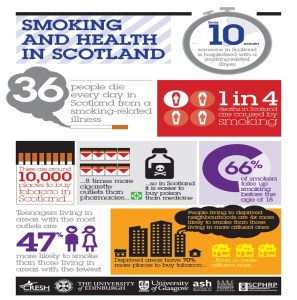
    smoking_infographic2Today we’re launching our hot-off-the-press infographic about Smoking and Health in Scotland.  In collaboration with Action on Smoking and Health (ASH) Scotland we’ve created this summary of some of the key statistics on smoking and health in Scotland, featuring some headline results from our own research.  Please use and circulate widely! (more…)

  • Is multiple environmental deprivation related to population health in Portugal?

    By Ana Isabel Ribeiro

    In our recently published paper (open access version here) we describe the development of a multivariate measure of physical environmental deprivation for the 278 municipalities of Portugal, and demonstrate its strong relationship with mortality rates. (more…)