Author: Rich Mitchell

  • A Quarter of the Population Isn’t Visiting Green Spaces – why does that matter and what can you do about it? 

    Ask most people whether green spaces are good for health and you’ll get a fairly confident “yes”. The evidence backs them up. Time spent in parks, woods, gardens, coasts and waterways is linked to lower stress, better mental health, more physical activity, and greater social connection. For people experiencing health problems and even other disadvantages, that connection with nature may be especially powerful. Green spaces potentially act as a health equaliser in communities where access to other health-supporting resources is limited.

    So, here’s the question those of us who evangelise about the health benefits of green spaces don’t ask nearly often enough: who isn’t going?

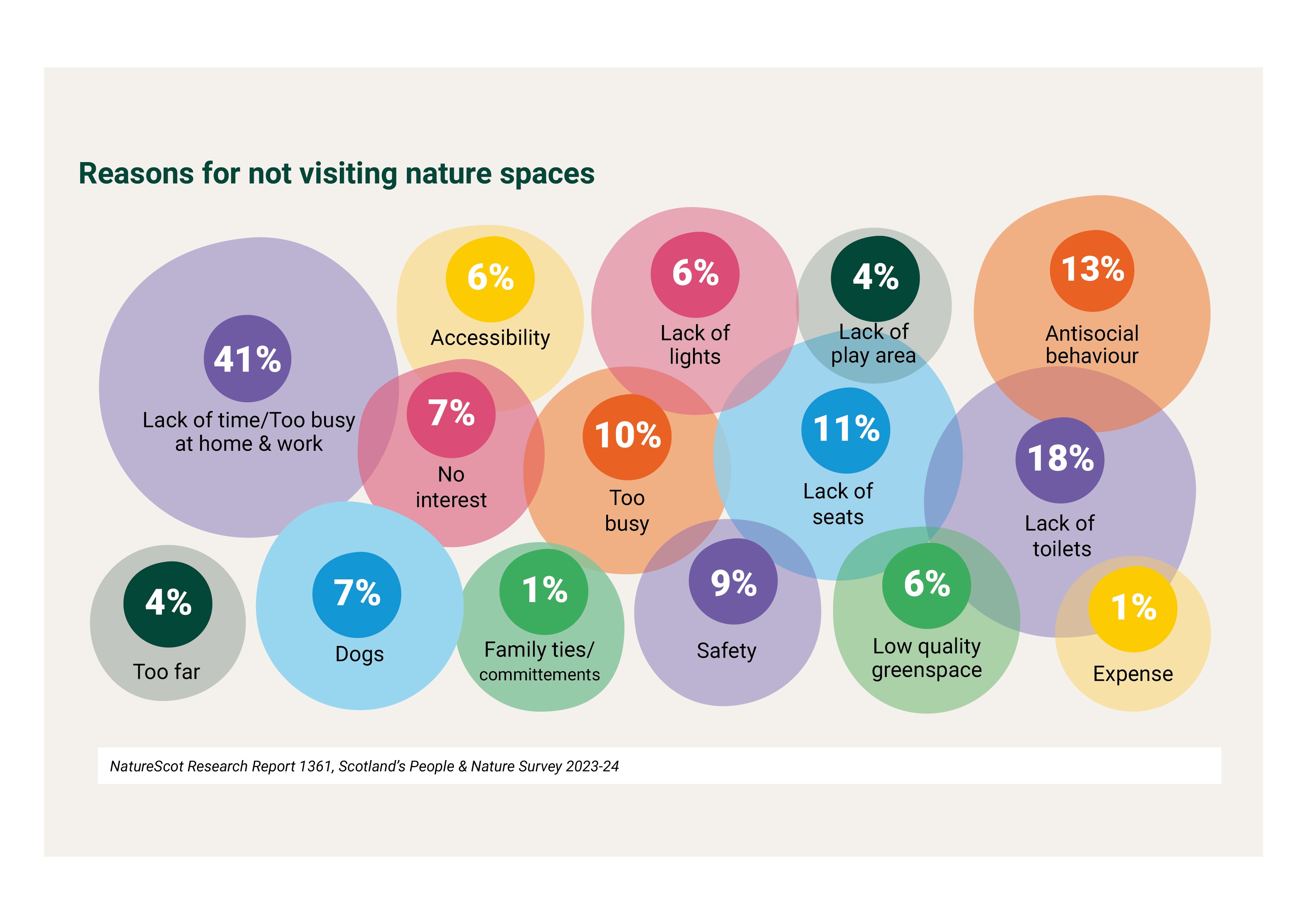
    Around a quarter of the UK population visits green or blue spaces less than once a month. In Scotland, NatureScot surveys put that figure at roughly 26%. Research across 33 European cities found comparable numbers. These aren’t people who lack green spaces nearby. Many of them live within walking distance of a park. Yet for a complex web of reasons, some visible, some much harder to see, they simply don’t go. 

    Graphic quantifying reasons for not visiting nature spaces

    This is what we call the ‘green gap’ and it matters enormously, because the people least likely to visit green spaces are disproportionately the same people who stand to benefit most from them: those with long-term health conditions, people from lower socioeconomic backgrounds, older adults, people with disabilities, and people from minority ethnic groups. In other words, the very populations for whom a regular walk in the park could make the biggest difference are the ones researchers, policy makers and practitioners have consistently failed to reach.

    Until now, research and policy have had no coherent framework for thinking about why.

    Introducing the Green Gap Framework

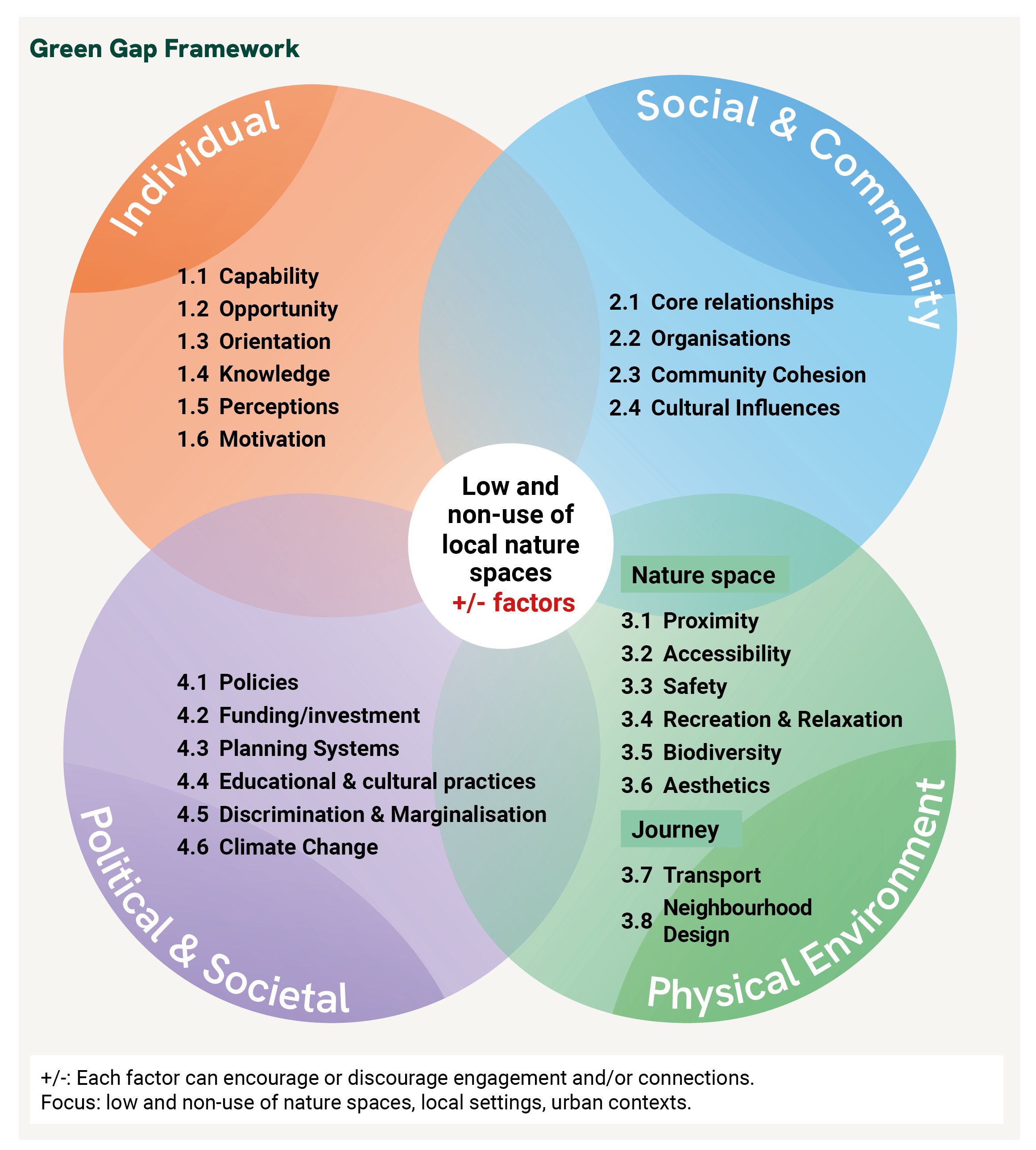
    Published in Landscape and Urban Planning, the Green Gap Framework is the first theoretical framework designed specifically to map and explain non and low use of urban greenspaces. Developed by members of CRESH, Rob Bushby, and the GroundsWell consortium, the framework is the product of an extensive iterative process involving literature review, expert consultation, and collaboration with over 100 researchers, policymakers, planners, practitioners, and members of the public across the UK, Europe, and beyond.

    What the framework offers is something deceptively simple but genuinely novel: a shared language and a structured way of thinking about all the reasons someone might not visit a green space. Not just the obvious ones. The framework organises these reasons across four interconnected domains.

    Domain 1 – Individual. This covers the factors unique to a person: their physical and mental capability to visit, the time and opportunity they have, their knowledge of what’s nearby, their attitudes and prior experiences, and  – crucially – their motivation or lack of it. 

    Domain 2 – Social and Community. Whether or not someone visits a green space is also shaped by the people and groups around them; family members and friends who model or discourage outdoor habits, community organisations, schools and employers, the cohesion and perceived safety of a neighbourhood, and the cultural significance (or absence) of green spaces in someone’s background.

    Domain 3 – Physical Environment. This is where most existing policy and research has focused; the characteristics of green spaces themselves (proximity, accessibility, safety, aesthetics, biodiversity, facilities for recreation) as well as the journey to get there (transport links, neighbourhood design, roads and infrastructure). These factors matter enormously, but they’re not the whole story.

    Domain 4 – Political and Societal. Perhaps the most overlooked domain: the policies, funding decisions, planning systems and cultural practices that shape which communities have well-maintained, welcoming green spaces and which do not. This domain also considers discrimination and marginalisation, and the impacts of climate change.

    Each factor in the framework is marked with a +/− symbol to reflect an important insight: the same factor that enables one person to use a green space may be the very thing that prevents another. Dogs in a park are a draw for some visitors and a deterrent for others. A park that feels safely secluded to one person may feel isolated and threatening to another.

    What Makes This Different?

    Previous greenspace research has tended to ask, ‘what are the benefits of green spaces, and how do we design better ones?’ Those are valuable questions, but they assume the barrier is primarily a physical one; if you build it well enough, people will come.

    The Green Gap Framework challenges that assumption directly because interventions that focus only on physical improvements risk missing the deeper drivers of non-use and, at worst, can actively worsen inequalities.

    The framework also makes a deliberate and important methodological choice. Earlier drafts organised barriers around demographic categories: age, sex, ethnicity, disability. These were replaced with attitudinal and trait-based factors. The reason is significant: the framework’s purpose is not to predict in advance which groups won’t visit green spaces, but to explain why any group or individual might not, and to identify where intervention could help. This shift makes it far more useful across different communities and contexts.

    A Tool Built for Use and Change

    The framework was explicitly designed to be used beyond academia. We worked throughout its development with planners, park managers, third-sector organisations, and members of the public to ensure it would be genuinely applicable in the real world.

    The framework is designed to evolve. We have been very clear that this is not a finished product. Like the influential frameworks by Markevych et al. and Lachowycz and Jones that have shaped greenspace and health research, the Green Gap Framework is intended as a living tool, refined as empirical evidence accumulates and as different communities engage with it.

    The Bigger Picture

    Health inequalities are widening. The populations most affected by poor health are also those with the least access to the things that protect and restore health, including green space. At a time when public health budgets are under severe pressure, the case for low-cost, scalable interventions that can reach the people who need them most is urgent.

    Green and blue spaces are, in principle, free to access. They exist in or near most urban communities. They have a robust and growing evidence base for physical and mental health benefits. The problem is not the spaces themselves. The problem is the complex, multilevel web of barriers, individual, social, environmental, and systemic, which prevent too many people from using them.

    The Green Gap Framework doesn’t solve that problem, but it gives us, for the first time, a coherent way to think about it and a shared foundation from which researchers, planners, policymakers and practitioners can begin to work on it together.

    Find out more

    We have more information and assets for you, including a plain-language summary guide for practitioners and policy makers.

    The Green Gap Framework paper is published open access in Landscape and Urban Planning: https://doi.org/10.1016/j.landurbplan.2026.105663

    More resources, insights and use cases are available on the Green Gap section of the Groundswell website.

    GroundsWell is funded by the UK Prevention Research Partnership (MR/V049704/1).

  • CRESH web mapper back up!

    Thanks for your patience, the web mapper is back up. This might be a good time to check it out!

    The main web map allows you to view alcohol and tobacco outlet density for small neighbourhoods across Scotland. You can also map alcohol-related death rates, lung cancer and lung disease death rates. You can search by town or postcode and our download facility allows you to then download the data for either the whole of Scotland or selected areas. Information on the underlying data and how to use the webmap are available on the website, which you can find in our menu bar at the top of the page.

  • CRESH web mapper down

    We’re sorry that the web mapper is currently offline. Please bear with us whilst it’s fixed. We hope to have it back up at the start of April.

  • How do residents perceive alcohol availability and its impact on drinking behaviour?

    We have a new paper out in Health and Place, led by our colleagues Elena Dimova and Carol Emslie at GCU.

    We wanted to improve our understanding of how residents conceptualise alcohol availability and its impact on behaviours. The study used data collected here in Scotland, a country with particularly high levels of alcohol-related harm, to explore the perspectives of residents, on local alcohol availability and how it might affect drinking behaviours.

    We conducted 11 online focus groups with 45 participants, living in nine strongly contrasting neighbourhoods in Scotland, characterised by varying levels of alcohol retail density change, urbanity and deprivation. We explored participants’ perceptions of their local alcohol environment and alcohol availability, and any perceived relationship between alcohol availability and alcohol-related behaviours.

    What did we find? Our participants challenged established notions that alcohol availability is characterised primarily by density of alcohol outlets. Instead, they felt availability is about accessibility, ease of purchase and ubiquity of alcohol. Residents drew distinctions between areas of varying deprivation and conceptualised alcohol availability as complex, characterised by market segmentation, and related to price, advertising and the wider environment.

    This is one of the few papers so far that has explored residents’ perspectives of local alcohol availability and its relationship with alcohol use. It highlights that residents view alcohol availability as encompassing more than just the physical presence of outlets, recognising also the variety of outlet types and the connections between availability, pricing, and advertising.

    Policies to reduce local availability should consider residents’ perspectives and account for contextual factors such as shifts in the retail landscape and the availability of alcohol-free recreational alternatives.

  • New funded PhD opportunity…

    The following PhD project is available in the School of GeoSciences at the University of Edinburgh, UK. Please note the deadline for applications is Monday 30th March 2026

    Inequalities in outdoor and indoor air pollution in the UK and implications for health equalities. 

    Supervisors:  Prof Ruth Doherty (ruth.doherty@ed.ac.uk), Prof Jamie Pearce (jamie.pearce@ed.ac.uk), Prof Mark Miller (mark.miller@ed.ac.uk) (U. Edinburgh), Dr James Milner (LSHTM), Dr Massimo Vieno (UKCEH)

    Air pollutants such as nitrogen dioxide (NO₂) and particulate matter (PM₂.₅ and PM₁₀; particles with diameters of 2.5 or 10 micrometres) have relatively short lifetimes in the atmosphere. As a result, their concentrations vary sharply across space, with the highest levels typically found close to emission sources such as road traffic. This creates unequal exposure to air pollution, with people living near traffic and industrial sources facing much higher levels than those in suburban or rural areas, contributing to greater health inequalities among already disadvantaged groups.

    This project will use detailed measurements and high-resolution chemistry transport modelling to examine social inequalities in outdoor and indoor air pollution exposure in the UK and across the UK, and how these differences contribute to health inequalities across a range of health outcomes.

    See: https://geosciences.ed.ac.uk/study/degrees/research-degrees/phd-projects/physical-sciences?item=1857

    Project Highlights:

    • Learn methods and perform statistical and epidemiological analyses using air pollution, socio-economic and health datasets.
    • Use a state-of-the-art chemistry transport model used in UK national air quality assessments to simulate atmospheric composition.
    • Gain knowledge of fundamental atmospheric chemical species, processes, and their toxicity.
    • Analyse detailed atmospheric measurement data from UK “supersites” and gain experience with laboratory-based toxicity methods.
    • Use new indoor air pollution measurements currently being collected to examine inequalities in indoor air pollution exposure.
    • Be part of the large UKRI-funded interdisciplinary hub “INHABIT” exploring the health co-benefits of Net Zero for the indoor environment through collaboration across 10 UK universities.

    You will also join a large interdisciplinary, vibrant research network in the School of GeoSciences. You will be equipped with the science expertise to address core environmental health problems and climate action in your future career.

    Please see: https://study.ed.ac.uk/programmes/postgraduate-research/95-atmospheric-and-environmental-sciences for eligibility and how to apply, and contact the named supervisors at the email addresses listed above for enquiries. 

  • Website update in progress

    Here at CRESH we are (finally) getting around to a website refresh. Please bear with us whilst we reorganise and things look a bit clunky or don’t quite work as they should…

  • Job Opportunity: Green space quality

    We have a post available at the MRC/CSO Social and Public Health Sciences Unit in Glasgow, working on our project measuring green space quality, and looking at its association with health. It’s very cool.

    Apply here: https://my.corehr.com/pls/uogrecruit/erq_jobspec_version_4.jobspec?p_id=049068

    Closing Date: 8th March 2021

    Funding is approved on a full-time basis (35 hours) until 1st May 2023.

    As a successful candidate you will contribute to the project `Better Parks, Healthier for All?. This project will make a systematic, longitudinal assessment of associations between a range of green space qualities, and risk factors for/measures of cardiometabolic disease and poor mental health. This is a joint UK-Australia project, led in the UK by Prof Rich Mitchell and in Australia by Prof Xiaoqi Feng. Whilst the state and third sectors in both countries have blueprints for what to capture in measuring green space qualities, there are no spatially comprehensive validated secondary measures of quality available. This post is particularly focused on the co-production of measures of urban green space qualities for 4 cities in Scotland and Australia, using secondary map data, remote imagery including Google Earth and Lidar, and secondary crowd-sourced biodiversity measures.

    The successful candidate will also be expected to contribute to the formulation and submission of research publications and research proposals as well as help manage and direct this complex and challenging project as opportunities allow.

    Main Duties and Responsibilities

    1. Implement the access, analysis and interpretation of secondary spatial and satellite imagery data that will underpin an assessment of green space quality.
    2. Contribute to the creation and use of the green space quality measures and analysis of their association with measures of health cardiometabolic and mental health.
    3. Document research output including analysis and interpretation of all data, maintaining records and databases, drafting technical/progress reports and papers as appropriate.
    4. Establish and maintain your research profile and reputation and that of The University of Glasgow/ School/ Research Group, including establishing and sustaining a track record of independent and joint publications of international quality in high profile/quality refereed journals, enhancing the research impact in terms of economic/societal benefit, and gathering indicators of esteem.
    5. Contribute to surveying the research literature and environment, understanding the research challenges associated with the project & subject area, & developing/implementing a suitable research strategy.
    6. Present work at international and national conferences, at internal and external seminars, colloquia and workshops to develop and enhance our research profile.
    7. Contribute to the identification of potential funding sources and to assist in the development of proposals to secure funding from internal and external bodies to support future research.
    8. Contribute to developing and maintaining collaborations with colleagues in Australia, and across the research group/School/College/University and wider community (e.g. Academic and Industrial Partners).
    9. Contribute to programme / Unit meetings/seminars/workshops and Institute research activities to enhance the wider knowledge, outputs and culture of the Unit and Institute.
    10. Perform administrative tasks related to the activities of the Programme
    11. Keep up to date with current knowledge and recent advances in the field/discipline.
    12. Engage in personal, professional and career development, to enhance both specialist and transferable skills in accordance with desired career trajectory.
    13. Carry out modest teaching / supervision activities if and when requested by the Programme Leader.
    14. Undertake any other reasonable duties as required by the Programme Leader or Unit Director
    15. Contribute to the enhancement of the University¿s international profile in line with the University¿s Strategic Plan, Inspiring People Changing The World.

    For appointment at Grade 7:

    1. Perform the above duties with a higher degree of independence, leadership and responsibility, particularly in relation to planning, funding, collaborating and publishing research and mentoring colleagues.
    2. Establish and sustain a track record of independence and joint published research to establish and maintain your expert reputation in subject area.
    3. Survey the research literature and environment, understand the research challenges associated with the project & subject area, & develop/implement a suitable research strategy.

    Qualifications

    Essential
    A1. Scottish Credit and Qualification Framework level 10 (Honours degree) in a relevant subject or a cognate discipline, or equivalent

    For grade 7:
    A2 Normally Scottish Credit and Qualification Framework level 12 (PhD) or alternatively the equivalent in professional qualifications and experience, with experience of personal development in a similar or related role(s)

    Desirable:
    B1 An awarded (or recently submitted or near completion) PhD in subject specialism or equivalent

    Knowledge, Skills & Experience

    Knowledge & Skills

    Essential
    C1. A comprehensive and up to date knowledge of GIS (ArcGIS or QGIS) / spatial analysis as applicable to the relationships between environment and health.
    C2. Management & handling of big and/or spatial data, including parallel and/or automated processing techniques
    C3 Excellent communication skills (oral and written), including public presentations and ability to communicate complex date/concepts clearly and concisely.
    C4 Expertise in the access and use of satellite &/or aerial imagery for analysis of landscape features and content.
    C5 Excellent interpersonal skills including team working and a collegiate approach
    C6 Ability to search and synthesise literature from different disciplines.
    C7 Self-motivation, initiative and independent thought/working
    C8 Commitment to open research, through open data, open code, open educational resources, and practices that support replication.
    C9 Problem solving skills including a flexible and pragmatic approach

    For appointment at grade 7
    C10 Ability to lead the design and implementation of spatial analysis of relationships between environment and health
    C11 Ability to lead the drafting, revision, and submission of academic research articles.
    C12 Sufficient depth of relevant research experience, normally including sufficient postdoctoral experience in a related field, appropriate to an early career researcher

    Desirable
    D1. Knowledge of the impacts of urban natural environments on human health
    D2 Knowledge of urban analytics, &/or spatial ecology, &/or applied human/physical geography
    D3 Knowledge of the use of biomarkers and clinical measurements of cardiovascular / cardiometabolic health
    D4 Programming (ideally R or Python) or platforms (e.g., Google Earth Engine) for spatial data handling and analysis

    Essential

    Experience
    E1 Sufficient relevant research experience [or equivalent] appropriate to an early career researcher
    E2. Experience of running stakeholder workshops or similar
    E3. Experience of scientific writing
    E4. Proven ability to deliver quality outputs in a timely and efficient manner
    E5. Evidence of an emerging track record of publications in a relevant field

    For appointment at grade 7
    E6. Proven ability to deliver quality outputs in a timely and efficient manner
    E7. A strong track record of presentation and publication of research results in quality journals/conferences
    E8. Experience of making a leading contribution in academic activities
    E9. Ability to demonstrate a degree of independence as illustrated by identification of project objectives from assessment of the literature, design & analysis of experiments & drafting of papers.
    E10. Experience in undertaking independent research

    Desirable
    F1. Experience of collaborative working across disciplines.
    F2. Experience of using cardiovascular / cardiometabolic health indicators

    Standard Terms & Conditions:

    Salary will be on the University’s Research and Teaching Grade, 6/7 £29,176 – £32,817/£35,845 – £40,322 per annum.

    Funding is approved on a full-time basis (35 hours) until 1st May 2023.

    New entrants to the University will be required to serve a probationary period of 6 months.

    The successful applicant will be eligible to join the Universities’ Superannuation Scheme. Further information regarding the scheme is available from the Superannuation Officer, who is also prepared to advise on questions relating to the transfer of Superannuation benefits.

    All research and related activities, including grants, donations, clinical trials, contract research, consultancy and commercialisation are required to be managed through the University¿s relevant processes (e.g. contractual and financial), in accordance with the University Court’s policies.

    It is the University of Glasgow’s mission to foster an inclusive climate, which ensures equality in our working, learning, research and teaching environment.

    We strongly endorse the principles of Athena SWAN, including a supportive and flexible working environment, with commitment from all levels of the organisation in promoting gender equality.

    The University of Glasgow, charity number SC004401.

    Vacancy Ref : 049068, Closing date : 8 March 2021.

  • An atlas of change in Scotland’s built environment 2016-17

    By Laura Macdonald from the MRC/CSO  Social and Public Health Sciences Unit, University of Glasgow @theSPHSU

    Our neighbourhood environments change and evolve often; some changes are minor, while others involve major transformation. Change can take various forms; green space created or removed, existing housing or amenities demolished, new housing estates built, new motorways created, or existing transport infrastructure modified or extended. Change may affect neighbourhood residents’ physical or mental health, or health-related behaviours, to their benefit or to their detriment. To study how change in our neighbourhoods might affect our health we need robust information but data showing how our neighbourhoods are changing, at a fine geographic scale, for the whole of Scotland, did not exist – until now! This is why we created an atlas showing what’s changed, and an interactive mapping application which allows you to explore the data yourself. (more…)

  • Children in deprived areas encounter shops selling tobacco six times more frequently than those in well-off areas

    By Dr Fiona Caryl.

    Our new study  looking at exposure of children to tobacco retailing, recently published in the journal Tobacco Control, shows that an average 10-to-11-year-old child in Scotland comes within 10m of a shop selling tobacco 43 times a week. This rises to 149 times a week for children living in the poorest areas—six times more than the 23 encounters a week experienced by children living in affluent areas. This demonstrates an unexpectedly large inequality in the amount of times children are exposed to tobacco sales. Unexpected because in the same study we showed that tobacco outlets are 2.6 times more common around the homes of children living in the most deprived areas than the least. Yet we found a six-fold difference in exposure because we used GPS trackers (fully consented and ethics-approved, of course) to follow exactly where children moved through their environments. We found that most exposure came from convenience stores (41%) and newsagents (15%) on school days, with peaks before and after school hours. At weekends, we found most exposure came from supermarkets (14%), with a peak around midday.

    Why does this matter? This may not sound like a lot of exposure, and we might ask if a child is really exposed to tobacco just by being in or near a shop selling tobacco, especially after the ban on point-of-sale (POS) tobacco displays. But then we don’t actually know how many micro-exposures it takes to make a child think that smoking is a normal, acceptable and widespread behaviour rather than a major cause of premature death. Research into advertising suggests that the mere-exposure to indirect and incidental stimuli can influence attitudesnon-consciously when they’re repeatedly presented. The ban on POS tobacco displays has reduced children’s susceptibility to smoking, but children still notice tobacco on sale. In fact, recent research shows that the conspicuousness and prominence of tobacco in shops varies considerably between areas of high and low deprivation. And the difference in prominence has been increasing since the POS ban.

    The difference in the number of times children in poor areas are in or near to places selling tobacco is most concerning when you consider the pathways leading people to start smoking. Most adult smokers start when they are teenagers, and the availability of tobacco products is a key factor in in why people start to smoke and why they find it hard to give-up. Our findings raise important questions about when and where tobacco products are sold and the messaging this is sending to children.

  • Urban health and neighbourhood effects: PhD studentships at Glasgow Uni

    CRESH’s Rich Mitchell is part of the GCRF Funded Centre for Sustainable, Healthy and Learning Cities and Neighbourhoods (SHLC) at the University of Glasgow. The centre is offering 3 new PhD studentships which include a focus on neighbourhood and city effects on health. More details and how to apply can be found below and via the University’s Website: http://bit.ly/SHLCPhD

    Closing Date: 17 June 2018

    Research Topic

    Candidates are required to provide an outline proposal of no more than 1000 words. We are particularly interested in proposals that encompass any of the following topics:

    a) The development and operationalisation of indicators/classification/measures of spatial differentiation (including its temporal evolution) of neighbourhoods within SHLC case study cities, and the implications of spatial differentiation for access to public services;

    b) The development and operationalisation of indicators/classification/measures for lifelong learning in cities and neighbourhoods in the global south, including links to a range of life wide literacies;

    c) Qualitative/ethnographic studies of neighbourhoods in SHLC case study cities paying particular attention to the interaction between urban, health and education challenges

    d) Investigations of the impact of informality on social sustainability in neighbourhoods within SHLC case study cities, paying particular attention to the interaction between urban, health and education challenges

    e) Understanding the relationships between neighbourhood-level and city-level influences on residents’ health, paying particular attention to variations by health outcome, person and/or SHLC case study city/country.

    The award
    Both Home/EU and International applicants are eligible to apply. The scholarship is open to +3 (3 years PhD only) commencing in October 2018 and will provide: a stipend at the ESRC rate, 100% tuition fee waiver, and access to the Research Training Support Grant.

    How to Apply

    All applicants should complete and collate the following documentation then attach to a single email and send to socsci-scholarships@glasgow.ac.uk with the subject line ‘GCRF SHLC Scholarship application‘ by 17 June 2018

    1. Academic Transcript(s) and Degree Certificate(s)

    Final or current degree transcripts including grades and degree certificates (and official translations, if needed) – scanned copy in colour of the original documents.

    1. References

    2 references on headed paper (academic and/or professional).

    At least one reference must be academic, the other can be academic or professional. Your references should be on official headed paper. These should also be signed by the referee.

    If your referees would prefer to provide confidential references direct to the University then we can also accept the reference by email, from the referee’s official university or business email account to socsci-scholarships@glasgow.ac.uk clearly labelling the reference e.g. “<applicant name> CoSS Scholarship Reference”

    1. Copy of CV
    2. Research Proposal 

    Applicants are required to provide research proposal of not more than 1000 words. It should include:

    • a straightforward, descriptive, and informative title
    • the question that your research will address
    • a justification of why this question is important and worth investigating
    • an assessment of how your own research will engage with recent research on the subject
    • a brief account of the methodology and data sources you will use
    • References to sources cited in the proposal and an indicative wider bibliography (The references and bibliography are in addition to the 1000 words).

    For more information please visit the University’s website (http://bit.ly/SHLCPhD) or contact SHLC’s Senior Business Manager Gail Wilson gail.wilson@glasgow.ac.uk