Category: Physical Environment

  • New funded PhD opportunity…

    The following PhD project is available in the School of GeoSciences at the University of Edinburgh, UK. Please note the deadline for applications is Monday 30th March 2026

    Inequalities in outdoor and indoor air pollution in the UK and implications for health equalities. 

    Supervisors:  Prof Ruth Doherty (ruth.doherty@ed.ac.uk), Prof Jamie Pearce (jamie.pearce@ed.ac.uk), Prof Mark Miller (mark.miller@ed.ac.uk) (U. Edinburgh), Dr James Milner (LSHTM), Dr Massimo Vieno (UKCEH)

    Air pollutants such as nitrogen dioxide (NO₂) and particulate matter (PM₂.₅ and PM₁₀; particles with diameters of 2.5 or 10 micrometres) have relatively short lifetimes in the atmosphere. As a result, their concentrations vary sharply across space, with the highest levels typically found close to emission sources such as road traffic. This creates unequal exposure to air pollution, with people living near traffic and industrial sources facing much higher levels than those in suburban or rural areas, contributing to greater health inequalities among already disadvantaged groups.

    This project will use detailed measurements and high-resolution chemistry transport modelling to examine social inequalities in outdoor and indoor air pollution exposure in the UK and across the UK, and how these differences contribute to health inequalities across a range of health outcomes.

    See: https://geosciences.ed.ac.uk/study/degrees/research-degrees/phd-projects/physical-sciences?item=1857

    Project Highlights:

    • Learn methods and perform statistical and epidemiological analyses using air pollution, socio-economic and health datasets.
    • Use a state-of-the-art chemistry transport model used in UK national air quality assessments to simulate atmospheric composition.
    • Gain knowledge of fundamental atmospheric chemical species, processes, and their toxicity.
    • Analyse detailed atmospheric measurement data from UK “supersites” and gain experience with laboratory-based toxicity methods.
    • Use new indoor air pollution measurements currently being collected to examine inequalities in indoor air pollution exposure.
    • Be part of the large UKRI-funded interdisciplinary hub “INHABIT” exploring the health co-benefits of Net Zero for the indoor environment through collaboration across 10 UK universities.

    You will also join a large interdisciplinary, vibrant research network in the School of GeoSciences. You will be equipped with the science expertise to address core environmental health problems and climate action in your future career.

    Please see: https://study.ed.ac.uk/programmes/postgraduate-research/95-atmospheric-and-environmental-sciences for eligibility and how to apply, and contact the named supervisors at the email addresses listed above for enquiries. 

  • What is ‘on the ground’ in a city linked to levels of inequality in life satisfaction

    In a European-wide study of 63,554 people from 66 cities in 28 countries, we found links between urban design and levels of inequality in life satisfaction. This is the first study to theorise and examine how the entire urban landscape may affect levels of and inequalities in wellbeing in a large international sample.

    Cities with an even distribution of facilities, housing and green space were linked with lower levels of inequality between residents’ life satisfaction levels, suggesting that more equal access to a range of facilities and types of land may help reduce the gap in life satisfaction between the most economically-deprived and most affluent residents of a city.

    There was a strong link between higher life satisfaction and living in cities with homes surrounded by natural, green space. However, lower life satisfaction was linked to living in cities that had more wasteland, more space dedicated to housing, and more space in which all the land is concrete or tarmacked.

    Implications for policy and planning.

    The findings of our study suggest that urban planning has a role to play in addressing inequalities in cities. Our finding that more equal distribution of land cover/use is associated with lower levels of socio-economic inequality in life satisfaction supports the idea that city environments could be equigenic – that is, could create equality.

    What people want or need from their city varies moment to moment, day to day, life stage to life stage. If a city is varied enough to offer people what they need, when they need it, it is likely to support a higher quality of life.

    Three Generation Out Walking

    Why understanding city design is important for population health and well-being?

    With the United Nations reporting that more than half the world’s population residing in urban areas and this proportion rising, it is important to understand how well-planned urban environment might improve, and reduce inequalities in, quality of life. Therefore, understanding the influence urban environments can have on all aspects of health and wellbeing is increasingly important. Cities are continuously evolving and there is ample opportunity to ensure these are healthier and happier place to live.

    What we did:

    We applied theory and methods from landscape ecology to explore associations between cities’ land cover/use, residents’ reported life satisfaction and within-city socio-economic inequalities in life satisfaction. We joined individual-level responses to the European Urban Audit (EUA) Perception Surveys (2012 and 2015) with city-level data from the European Urban Atlas classifying land cover/use into 26 different classes. Our sample included 63,554 people from 66 cities in 28 countries.

    The study, ‘Are urban landscapes associated with reported life satisfaction and inequalities in life satisfaction at the city level? A cross-sectional study of 66 European Cities’ is published in Social Science & Medicine (Open Access). The work was funded by The Medical Research Council (MRC) and Scottish Government Chief Scientist Office.

    By Rich Mitchell, Natalie Nicholls & Jon Olsen , Neighbourhoods and Communities programme, MRC/CSO Social and Public Health Sciences Unit, University of Glasgow.

  • Do people actually use the facilities in their home neighbourhood?

    Do people actually use the facilities in their home neighbourhood?

    This blog explores a key question in neighbourhood and health research: if there is a facility or amenity close to someone’s home, is it OK to assume they use it? Surprisingly, this assumption is at the heart of a lot of health and environment research.

    We often have data which tells us where facilities and amenities are, and we tend to make the assumption that proximity means use. So, for example, if we see that some neighbourhoods have more parks or more leisure facilities, we expect the people who live in that neighbourhood use them more. Understanding local amenity and facility use is important because we want to know whether / how these things affect health.

    With technological advances in recent years, studies have started to collect precise data which tell us exactly where people go using global position system (GPS) devices. We no longer have to assume, for example, that if there’s a park close to a child’s home, they will visit it. The GPS tracks we collect will tell us if they did or not. That presents an opportunity to test our assumptions.

    Do children use facilities they have access to in their home neighbourhood?

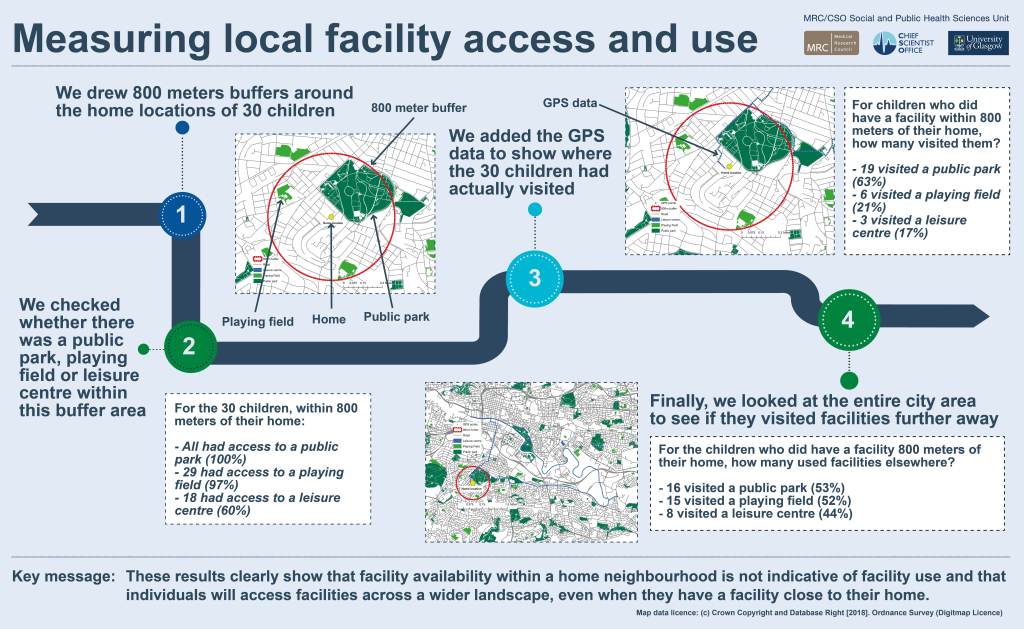
    Our team is interested in children’s use of facilities in and around their homes and to test whether we need GPS to research this we conducted an analysis of facility availability and facility use for 30 10-year-old children living in Glasgow. We used data from GPS devices worn by the children for eight days. These children were part of our ‘Studying Physical Activity in Children’s Environments across Scotland’ Study (SPACES).

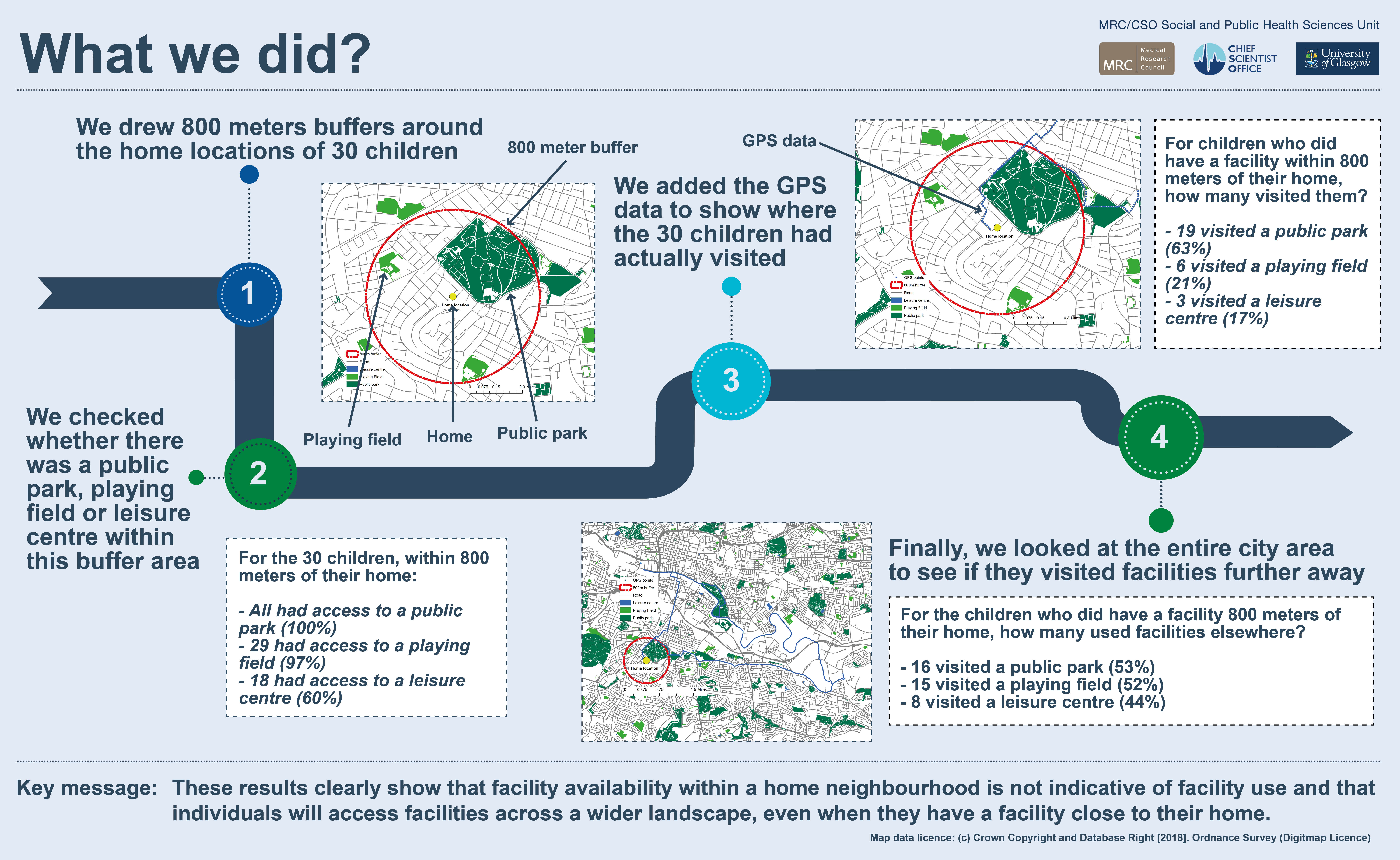
    The diagram below shows what we did. Our key finding was that facility availability in the home neighbourhood is not a good indicator of facility use; the children used facilities from across a much wider area in the city, even if they had a facility close to their home.  For example, 18 of the 30 children (60%) had a leisure centre within their ‘neighbourhood’ (which we defined as 800m around their home). Only 3 of the 18 actually visited that facility (as identified by their GPS tracks). Of those 18 children, 8 actually visited a leisure centre outside of their ‘neighbourhood’. We saw the same kind of pattern when exploring availability and visits to playing fields, public parks and libraries

    Blog graphic

    Are our results similar to other research?

    Yes, other studies that used GPS devices have found that children do spend time outside of their immediate home area for specific purposes. For example, a 2017 study by Chambers and colleagues in Wellington, New Zealand analysed leisure time GPS data (before and after school) in 114 children aged 11 to 13 years from 16 schools, and found that 38% of their leisure time was spent outside of the home neighbourhood (using a 750m buffer around the home). Time outside of the home neighbourhood was mostly spent visiting their school, other residential locations, and fast food outlets.

    These results, and those from similar studies, show that it is important not to treat what’s in someone’s immediate home neighbourhood as a good measure of what they do, or in epidemiological language ‘what they are exposed to’. We must challenge the idea that residential neighbourhood is an adequate way to capture the socio-environmental factors which contribute to health. Many people, including children, can and do access environments well beyond their immediate home neighbourhood. We think that a much wider geographic area should be considered when we’re asking questions about how environment affects health and we call this the city-wide landscape.

    What does this mean for future research?

    It’s clear that the ‘traditional’ approach which uses someone’s neighbourhood (often defined by a distance around their home, or an administrative area in which their home sits) to assess their access to facilities or exposure to environments is seriously flawed.

    • Other methodological approaches are required to measure ‘exposure’ to environment;
    • We must move beyond traditional fixed neighbourhood-health relationships (although we can’t ignore them);
    • We should embrace and integrate innovative technology to explore mobility (e.g. GPS and accelerometer).

    Of course, even when we’re able to see exactly where people go and what they do, we still need to understand the decisions people make about whether or not to visit or spend time at different places.

    By Jon Olsen, Research Associate with the Neighbourhoods and Communities programme, MRC/CSO Social and Public Health Sciences Unit, University of Glasgow.

  • Urban health and neighbourhood effects: PhD studentships at Glasgow Uni

    CRESH’s Rich Mitchell is part of the GCRF Funded Centre for Sustainable, Healthy and Learning Cities and Neighbourhoods (SHLC) at the University of Glasgow. The centre is offering 3 new PhD studentships which include a focus on neighbourhood and city effects on health. More details and how to apply can be found below and via the University’s Website: http://bit.ly/SHLCPhD

    Closing Date: 17 June 2018

    Research Topic

    Candidates are required to provide an outline proposal of no more than 1000 words. We are particularly interested in proposals that encompass any of the following topics:

    a) The development and operationalisation of indicators/classification/measures of spatial differentiation (including its temporal evolution) of neighbourhoods within SHLC case study cities, and the implications of spatial differentiation for access to public services;

    b) The development and operationalisation of indicators/classification/measures for lifelong learning in cities and neighbourhoods in the global south, including links to a range of life wide literacies;

    c) Qualitative/ethnographic studies of neighbourhoods in SHLC case study cities paying particular attention to the interaction between urban, health and education challenges

    d) Investigations of the impact of informality on social sustainability in neighbourhoods within SHLC case study cities, paying particular attention to the interaction between urban, health and education challenges

    e) Understanding the relationships between neighbourhood-level and city-level influences on residents’ health, paying particular attention to variations by health outcome, person and/or SHLC case study city/country.

    The award
    Both Home/EU and International applicants are eligible to apply. The scholarship is open to +3 (3 years PhD only) commencing in October 2018 and will provide: a stipend at the ESRC rate, 100% tuition fee waiver, and access to the Research Training Support Grant.

    How to Apply

    All applicants should complete and collate the following documentation then attach to a single email and send to socsci-scholarships@glasgow.ac.uk with the subject line ‘GCRF SHLC Scholarship application‘ by 17 June 2018

    1. Academic Transcript(s) and Degree Certificate(s)

    Final or current degree transcripts including grades and degree certificates (and official translations, if needed) – scanned copy in colour of the original documents.

    1. References

    2 references on headed paper (academic and/or professional).

    At least one reference must be academic, the other can be academic or professional. Your references should be on official headed paper. These should also be signed by the referee.

    If your referees would prefer to provide confidential references direct to the University then we can also accept the reference by email, from the referee’s official university or business email account to socsci-scholarships@glasgow.ac.uk clearly labelling the reference e.g. “<applicant name> CoSS Scholarship Reference”

    1. Copy of CV
    2. Research Proposal 

    Applicants are required to provide research proposal of not more than 1000 words. It should include:

    • a straightforward, descriptive, and informative title
    • the question that your research will address
    • a justification of why this question is important and worth investigating
    • an assessment of how your own research will engage with recent research on the subject
    • a brief account of the methodology and data sources you will use
    • References to sources cited in the proposal and an indicative wider bibliography (The references and bibliography are in addition to the 1000 words).

    For more information please visit the University’s website (http://bit.ly/SHLCPhD) or contact SHLC’s Senior Business Manager Gail Wilson gail.wilson@glasgow.ac.uk

  • TOBACCO OUTLET DENSITY AND PATHWAYS TO SMOKING AMONG TEENAGERS

    Why are adolescents that live in areas with high concentrations of tobacco shops more likely to smoke?

    New findings suggest Scottish teenagers living in areas with a high density of shops selling tobacco have greater knowledge about cigarette brands.

    Earlier work in Scotland found that adults and adolescents living in areas with high densities of shops selling tobacco were more likely to smoke. Public health researchers have suggested that restrictions on tobacco retail outlet density are a potential ‘new frontier’ in the long-running campaign to achieve a tobacco ‘endgame’. However, the reasons why exposure to greater numbers of tobacco outlets is associated with smoking are unclear and the types of restrictions on retail density that might best support this public health goal are not known.

    SALSUS _Q_cover_2A new study by CRESH has explored possible pathways linking tobacco outlet density to smoking among adolescents. Our work used responses from 22,049 13 and 15 year olds to the 2010 Scottish School Adolescent Lifestyle and Substance Use Survey. Data from the Scottish Tobacco Retailers Register were used to calculate a measure of the density of tobacco outlets around the survey respondents’ homes.

    We were interested to know whether adolescents in areas with more tobacco outlets had better knowledge of tobacco products, and so assessed how many cigarette brands they could name. We also looked at whether adolescents in high outlet density areas had more positive attitudes about smoking as it has been suggested that exposure to outlets and the tobacco marketing and purchasing found within them may ‘normalise’ smoking. We examined whether in areas where there are more tobacco outlets it may be easier for adolescents to make underage cigarette purchases. Finally, we considered tobacco price, assessing whether in areas with more tobacco shops, and more retail competition, cigarettes were cheaper. (more…)

  • Jobs at the GCRF Centre for Sustainable, Healthy and Learning Cities and Neighbourhoods

    Five Research Fellow posts are available at the GCRF Centre for Sustainable, Healthy and Learning Cities and Neighbourhoods (SHLC). SHLC is one of the 37 major projects funded for 4 years by the Global Challenges Research Fund (GCRF) Research Councils UK Collective Fund, which aims to build upon research knowledge in the UK, and strengthen research capacity overseas, to help address challenges in the developing countries.

    SHLC will conduct comparative studies of urbanisation and the formation and differentiation of neighbourhoods in cities in order to address the challenges associated with large-scale rural-to-urban migration in Africa and Asia. The Centre, based at Glasgow, has eight international partners in South Africa, Tanzania, Rwanda, India, Bangladesh, China and the Philippines.

    These jobs require expert knowledge in the areas of education, health, or urban studies in relation to developing countries from the perspective of development studies, geography, urban planning, urban studies, migration, public policy or other relevant social science disciplines.

    Specifically, we expect each of the five posts to contribute specialist knowledge to the Centre in at least one of the following areas:

    • Cities, urbanisation and urban development in Africa, South Asia and/or East Asia
    • Education policy research and provision in developing countries
    • Health policy research and health facility provision in developing countries
    • Quantitative research and analytical skills including social survey, spatial analysis, GIS, Big Data.
    • Qualitative research and analytical skills and methods

      For further information and applying, please visit the following web site:
      https://www.gla.ac.uk/it/iframe/jobs/

      Search College of Social Sciences (Job Reference Number: 019448) Closing Date: 13th December 2017

  • Is multiple environmental deprivation related to population health in Portugal?

    By Ana Isabel Ribeiro

    In our recently published paper (open access version here) we describe the development of a multivariate measure of physical environmental deprivation for the 278 municipalities of Portugal, and demonstrate its strong relationship with mortality rates. (more…)

  • Are people in poor health more likely to move to poorer quality physical environments?

    By Helena Tunstall

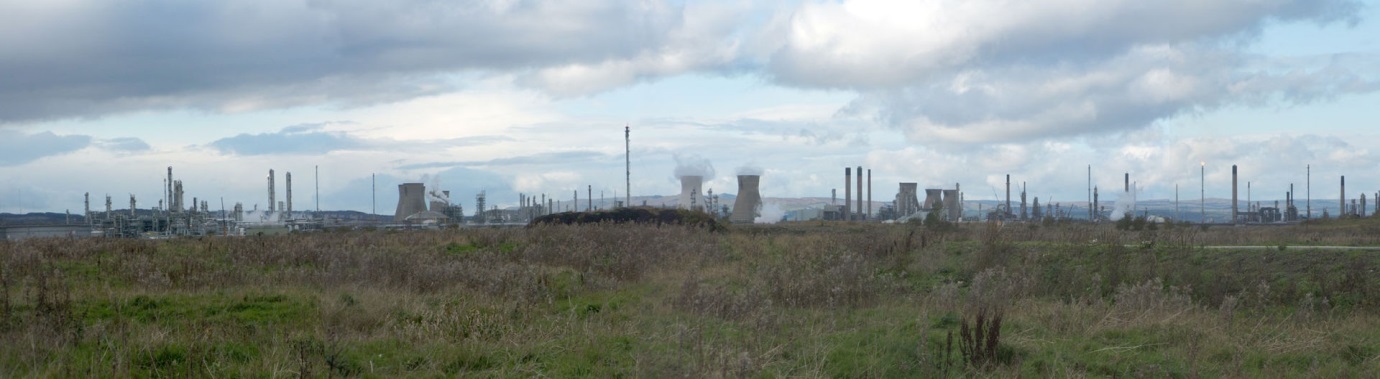
    Grangemouth Refinery, UK
    Grangemouth Refinery, UK

    It is well known that people living in neighbourhoods with poorer quality physical environments tend to have worse health than those living in better quality environments. For example, those in areas with higher levels of air pollution have greater risk of death from respiratory and cardiovascular disease. However, the vast majority of these studies do not consider the possibility that patterns of residential moves may concentrate people with poorer health in certain types of environments. This is important because it is feasible that the links between the environment and health may, at least partially, be explained by the migration of people with poorer health to poor quality environments. (more…)

  • Does deindustrialisation explain low levels of physical activity in the UK?

    by Esther Rind

    In the UK, as in many other affluent countries, levels of physical activity have been declining in recent decades. In many areas with a history of heavy manual employment levels of physical activity are particularly low. This has been linked to a considerable reduction in work-related activities, coupled with a generally more sedentary life-style and the development of  broader environmental factors unconducive to physical activity (e.g. increased traffic makes walking and cycling less safe and attractive). Furthermore, previous research has highlighted that participation in leisure-time physical activity is relatively low across those employed in physically demanding industries. Low levels of recreational physical activity in combination with a considerable loss of work activity would therefore result in particularly low activity levels in the former manual workforce. (more…)

  • Social differences in pollution across the EU may help to explain health inequalities

    As a European Commission report and an important academic paper have recently reminded us, air pollution remains a persistent threat to population health across Europe. Pollutants such as particulate matter and ozone are among the leading causes of premature mortality and respiratory-related health outcomes. Globally, exposure to air pollution ranks as one of the top ten risk factors for health. (more…)