
We recently developed a project summary for an ESRC-funded study looking at the impact of the financial crisis and subsequent austerity measures on mental health and wellbeing in the UK. The summary for the CRESH project (full title: Recession, austerity and health: changing area socio-economic conditions and their relationship to individual health and wellbeing outcomes in Scotland) includes the key findings, links to papers published, details of some of the dissemination activities, and other useful resources. You can read more in the pdf below:
Tag: health inequalities
-
Being a Scout or Guide protects mental health and narrows inequalities in later life
By Rich Mitchell and Chris Dibben

Today, with colleagues from the Longitudinal Studies Centre Scotland at Edinburgh University, we have published a study
which found that being in the Guides or Scouts as a child seems to protect your mental health long into adulthood. Those who were in the Guides or Scouts were about 18% less likely to have a mood or anxiety disorder at age 50, than those who were not. This protective link seems especially strong for children who grew up in less advantaged households, so much so that the usual ‘gap’ in mental health between those from richer and poorer backgrounds does not exist among those who were Scouts or Guides. (more…) -
Regions of Europe gaining migrants have lower death rates
By Helena Tunstall
New research just published by CRESH in the European Journal of Public Health suggests there is a strong correlation between net migration, 2000-2010, and age- and sex- standardised death rates, 2008-2010 among the regions of Europe (Figure 1). The recent ‘migrant crisis’ in Europe has ensured that European political debate about migration, long centred on immigration, has continued to focus upon areas receiving migrants. This analysis suggests however that difficulties associated with immigration are the problems of advantage. Regions of Europe which experienced significant population growth through migration, were found mostly in Western countries with higher incomes and lower death rates. In contrast, Europe regions with net out-migration, predominantly located in the East, are burdened by the combined problems of low incomes, high death rates and population decline.
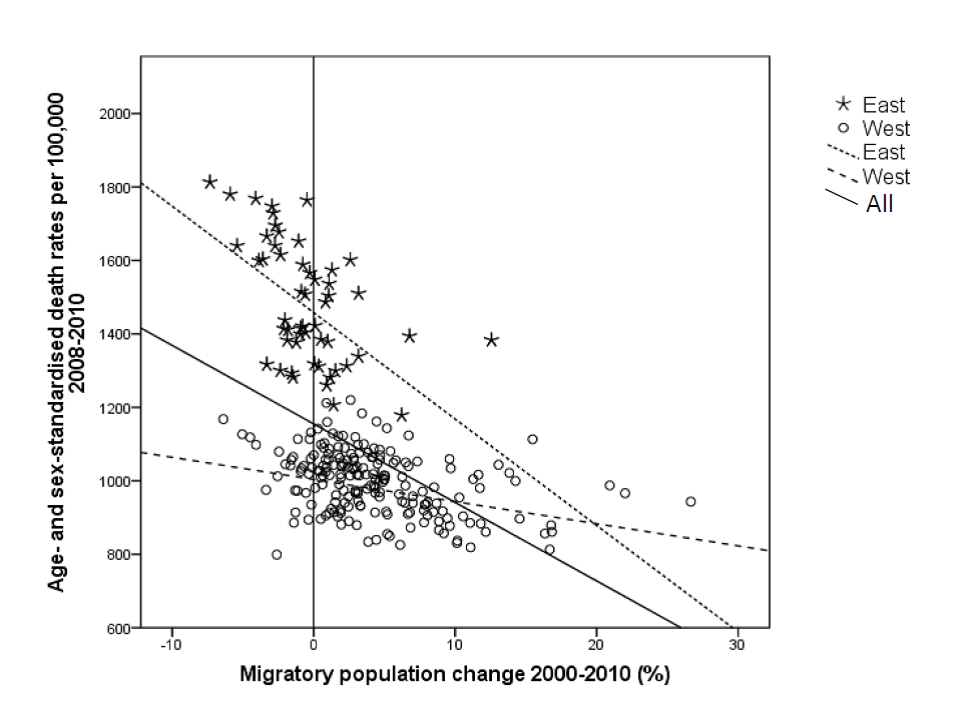
Figure 1 Death rates and migration among European regions -

Financial distress and inequalities in wellbeing across 13 European countries
Governments are increasingly recognising the wellbeing of their citizens as a policy priority. But in times of economic difficulty the welfare ‘safety net’ is often reduced, which may adversely affect the wellbeing of those most threatened by financial insecurities. Focusing on social inequalities in wellbeing across different countries – as we do in our latest paper – is therefore crucial.
-
Alcohol and Health in Scotland: Key Stats
As MSPs meet in the Scottish Parliament today to debate progress made against Scotland’s Alcohol Strategy, we’re launching a timely infographic to highlight the very real dangers of the oversupply of alcohol in our society, and the knock-on implications for health and inequality.

-
How difficult life events influence risk of mental health problems and moves to deprived neighbourhoods
We’ve just published a journal article that assesses the links between difficult life events, residential moves and spatial inequalities in mental health in the UK.
 We find that people that move following difficult life events, such as relationship breakdown and eviction, have poor mental health and distinctive patterns of mobility.
Difficult life events appear to both harm mental health and residential opportunities, increasing the likelihood that people with poor mental health will live in socio-economically deprived neighbourhoods. Moves related to difficult life events could reinforce socioeconomic inequalities in health between areas by concentrating people with poor health in disadvantaged areas.
-
Mapping life expectancy in Scottish Parliamentary Constituencies
By Helena Tunstall, Elizabeth Richardson & Jamie Pearce
New life expectancy at birth figures for 2011-2013 for Scottish Parliamentary Constituencies have just been released by National Records of Scotland (NRS). We’ve mapped and graphed these data to illustrate the latest geographical patterns of mortality in Scotland. (more…)
-
‘An environment where young people choose not to smoke’ is not one where tobacco products are sold on every street corner
By Niamh Shortt
Teenagers are more likely to smoke if they live in areas with the highest number of tobacco retailers. Our paper led by Niamh Shortt, published today in Tobacco Control, examined the relationship between tobacco outlet density and smoking habits of 13 and 15 year olds in Scotland. (more…)
-
Social differences in pollution across the EU may help to explain health inequalities
As a European Commission report and an important academic paper have recently reminded us, air pollution remains a persistent threat to population health across Europe. Pollutants such as particulate matter and ozone are among the leading causes of premature mortality and respiratory-related health outcomes. Globally, exposure to air pollution ranks as one of the top ten risk factors for health. (more…)

 CRESH
CRESH 