Tag Archives: tobacco

Could a tobacco license scheme in Scotland disincentivise tobacco sales?

The Scottish Government has committed to achieving a smoke-free generation by 2034. This ambitious goal has sparked debate about which measures will drastically reduce tobacco use and sales of tobacco products. One option is the introduction of a tobacco license scheme. A new study in Scotland from the SPECTRUM team shows that the introduction of a tobacco license scheme has the potential to disincentivise tobacco sales and reduce the availability of tobacco products.

In 2010, the Scottish Government introduced a registration system that was mandatory for businesses selling tobacco. However, there is no cost associated with registering to sell tobacco products. One option for helping to meet the smoke-free generation target is the introduction of a tobacco licensing scheme in Scotland.  

A tobacco retail license is a regulatory mechanism that requires retailers to purchase a special license to legally sell tobacco products. Tobacco license schemes are crucial for monitoring sales of tobacco products, reducing illicit sales, and enforcing regulations such as sales prohibition to minors. By charging fees to obtain a license can increase the cost of selling tobacco, making the product more expensive for consumers and less profitable for retailers. Consequently, this can lead to reduced tobacco product availability as retailers may choose to diversify their business models away from tobacco. A tobacco retailer reduction has been widely associated with lower smoking prevalence and fewer tobacco-attributable diseases.

However, the implementation of license fees has faced challenges from retailers and the tobacco industry, who raise concerns about their impact on business profitability. Retailers also provide essential local services and if the introduction of a tobacco license fee undermines the viability of the business, then this could negatively impact local communities. Therefore, the public health benefits of fee-based license systems that reduces tobacco availability have to be considered against the potential financial impacts on retailers.

Although many countries worldwide have considered different forms of license schemes, little is known about the effectiveness of these different schemes in disincentivising tobacco sales and their financial impacts on retailers.

Simulating the implementation of a tobacco license fee in Scotland: a case of study

As part of the SPECTRUM Consortium we addressed this question by analysing data from over one million commercial transactions across 179 smaller retailers (convenience stores) in Scotland between 2019 and 2022. We found that stores generate an annual median of £15,859 revenue from tobacco sales. Retailers in the most deprived areas of Scotland received 1.6 times more revenue than those in low-deprivation neighbourhoods. Moreover, urban retailers obtained 2.3 times higher revenues than rural stores (see table 1 below).

All RetailersHigh deprived areasMedium deprived areasLow deprived areasUrban areasRural areas
Median Gross Revenues£15,859£18,403£17,694£11,609£18,247£7,638
Table 1. Baseline annual median revenues from tobacco sales among retailers by area types within 2019 and 2022.

We found that the magnitude of the financial impacts of schemes on Scottish retailers varied in relation to the level at which the fee was set. For instance, adopting a low license fee similar to the one operating in New Brunswick, Canada, (a universal fee of CA$50/year, approximately £29/year), would result in a median tobacco revenue reduction of 0.18% among retailers in Scotland. However, if following Finland’s example of requiring a universal fee of €500/year (approximately £428/year) smaller retailers in Scotland would see their revenues reduced by 2.70% (see table 2 below). In both cases, the impacts of these licenses’ fees may not deter tobacco sales. In order to achieve a significant revenues reduction, such as a 30% reduction, would require a universal fee to be set at £4,758/year, which is substantially higher than those currently active in other countries.

Additionally, our results showed that each scheme type impacted differently on retailers located in different types of areas of the country. Universal and urban/rural flat fees would result in higher revenues reductions for retailers in low deprivation areas. Using a high-level universal fee (similar to Finland), results in a revenue reduction of 3.61% in low deprivation areas. This decline is more significant than the 2.70% reduction observed in high deprivation neighbourhoods. In contrast, volumetric schemes would lead to similar percent revenue reductions across all retailers.

Fee scheme and levelAll retailersHigh DeprivedMedium deprivedLow deprived
Universal low: £29/yr-0.18%-0.16%-0.17%-0.25%
Universal medium:£139/yr-0.88%-0.76%-0.79%-1.20%
Universal high: £428/yr-2.70%-2.32%-2.42%-3.67%
Volumetric low: £0.06/1000 sticks-0.18%-0.18%-0.18%-0.18%
Volumetric medium: £0.29/1000 sticks-0.86%-0.87%-0.89%-0.87%
Volumetric high: £0.91/1000 sticks-2.70%-2.72%-2.78%-2.73%
Urban/Rural low: U=£33/yr R=£14/yr-0.18%-0.17%-0.18%-0.22%
Urban/Rural medium: U=£161/yr R=£67/yr-0.88%-0.83%-0.86%-1.07%
Urban/Rural high: U=£493 R=£206/yr-2.70%-2.53%-2.65%-3.27%
Table 2. Median percentage reduction in tobacco revenues across retailers after the implementation of different license fees by area types.

Implications for Tobacco Control policies

These findings have implications for how we develop our approach to reducing tobacco harms in Scotland. Our study showed the potential of license fee schemes to disincentivise tobacco sales as they effectively increase the cost of selling tobacco. However, to significantly impact tobacco revenues and encourage retailers to diversify their business models away from tobacco sales, this policy would necessitate the implementation of relatively high-level fees.

The study described unequal financial impacts from each license scheme among retailers. The effectiveness of universal and urban/rural flat fees to reduce tobacco outlet availability could be questioned, as they would have a lower impact on retailers in high deprivation areas. These areas are typically targeted in tobacco control efforts since they present the highest densities of tobacco retailers and the worst smoking outcomes.

In contrast, volumetric fees could ensure an equal reduction of tobacco revenues across all retailers. Nevertheless, retailers with greater sales volume, more diversified business models (large retailers and supermarkets) or located in more profitable neighbourhoods (ie, urban areas) might have greater financial resources to cope with a given loss of 10% of their profits compared with other retailers.

Policymakers should carefully design and implement policies that maximise a reduction in tobacco outlet availability in all areas to mitigate smoking-related harms without threatening retail viability. One possible strategy in Scotland might include a modest flat fee, considering a lower fee in rural areas where retailers might be more vulnerable to potential shutdowns (ie, urban/rural scheme), along with an additional moderate volumetric fee.

Find out more about this study

The full study methods, findings and discussion of this study are published in Tobacco Control: “Geographical differences in the financial impacts of different forms of tobacco licence fees on small retailers in Scotland”.

About the author:

Roberto Valiente is postdoctoral researcher in Health and Environment at the Centre for Research on Environment, Society and Health (CRESH) and the SPECTRUM Consortium in the University of Edinburgh. His work is focused on the use of Geographic Information Systems to explore how the physical and social environment may shape population behaviours and health. His current research is focused on the study of commercial determinants of health from a spatial perspective, particularly those related with tobacco and alcohol issues.

Is it time to reconsider the impact agenda?

By Niamh K Shortt

In our latest paper published in Social Science and Medicine we critique the way ‘impact’ is measured within the UK’s Research Excellence Framework* (REF) and in doing so we propose an alternative measurement, one based on enlightenment and process rather than outcomes.

Water_drop_impact_on_a_water-surface
Source: commons.wikimedia.org/wiki/File:Water_drop_impact_on_a_water-surface.jpg


Continue reading Is it time to reconsider the impact agenda?

Seeing e-cigarettes in shops may influence their use by teenagers

By Jamie Pearce

Adolescents who recall seeing e-cigarettes in shops are more likely to have tried them in the past and are more likely to intend to try them in the future, according to a study published in the open access journal BMC Public Health.

16004247125_95069f5207_z

Source: http://www.ecigclick.co.uk. Creative Commons License

Continue reading Seeing e-cigarettes in shops may influence their use by teenagers

Scotland’s poorest neighbourhoods have the most shops selling alcohol and tobacco

By Niamh K Shortt

New research published this week in BMC Public Health by the CRESH team, and colleagues in Global Public Health, has found that Scotland’s most deprived neighbourhoods have the highest availability of both tobacco and alcohol outlets.  The average density of tobacco outlets rises from 50 per 10,000 population in the least income deprived areas to 100 per 10,000 in the most deprived areas.  For alcohol outlets licensed to sell alcohol for consumption off the premises the figures were 25 per 10,000 in the least income deprived areas rising to 53 per 10,000 in the most income deprived areas.

CIgarettes and Alcohol. By CharlesFred, Flickr. Creative Commons Licence.
Source: CharlesFred, Flickr. Creative Commons Licence.

Continue reading Scotland’s poorest neighbourhoods have the most shops selling alcohol and tobacco

Neighbourhood availability of tobacco is likely to be a factor in explaining adult smoking in Scotland

In our new paper published in Nicotine & Tobacco Research we find that adults in Scotland living in environments with a greater availability of tobacco outlets are more likely to smoke, and less likely to quit. This follows on from our earlier work, in which we found that teenagers in Scotland are more likely to smoke if they live in areas with the highest number of tobacco retailers.cigarette-counter-725x544 Continue reading Neighbourhood availability of tobacco is likely to be a factor in explaining adult smoking in Scotland

Empowering communities: An interactive tobacco and alcohol outlet density webmap for Scotland

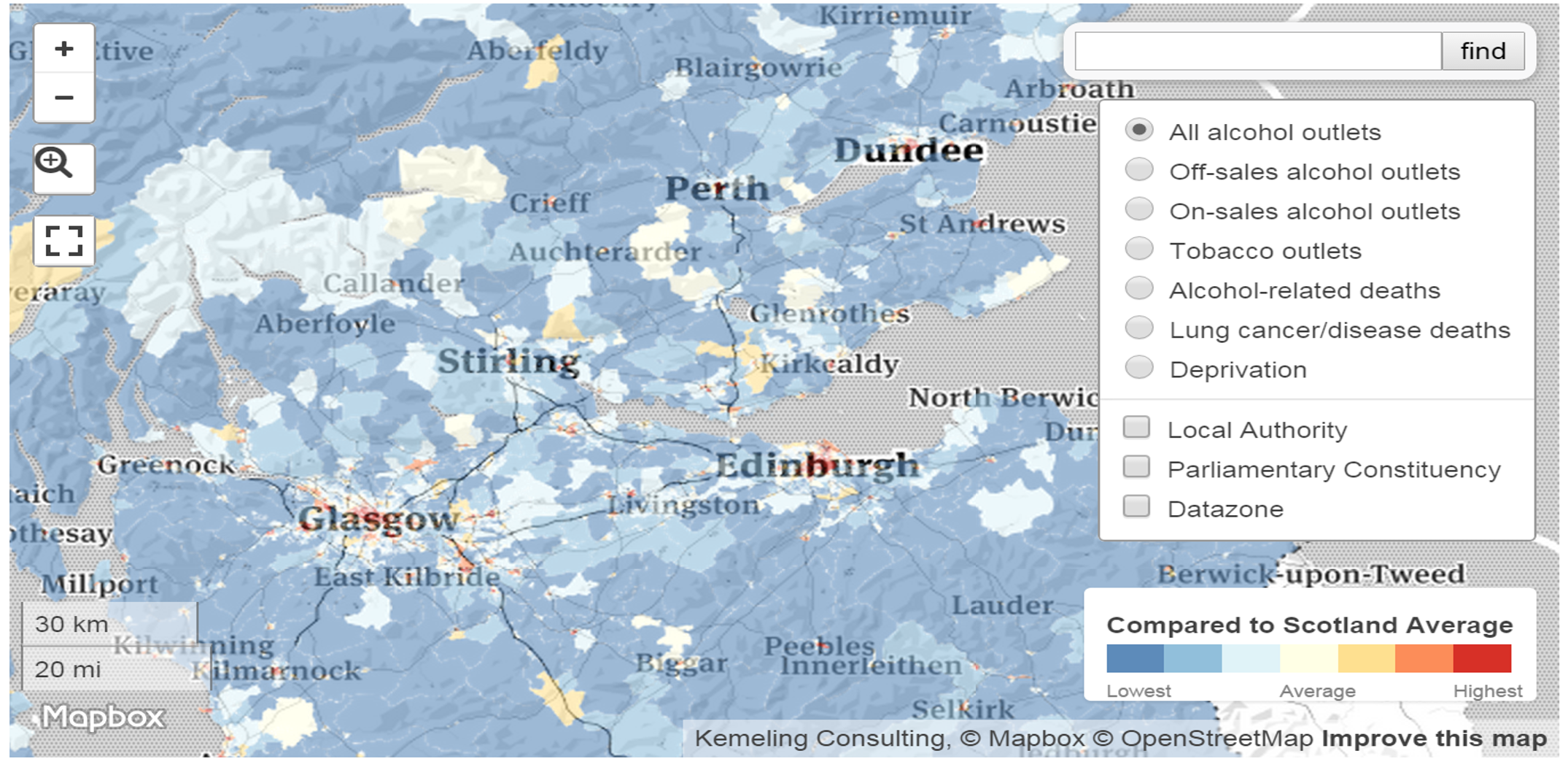
Today we are launching an interactive webmap that allows users to map tobacco and alcohol outlet density, and related health outcomes, for neighbourhoods (‘datazones‘) across Scotland.  The underlying data we have collected and assembled can also be freely downloaded for use.  Our research from Scotland shows that outlet density matters for health:

  • areas with the highest alcohol outlet density have double the death rate of those with the lowest densities (see our blog postreport and infographic)
  • adolescents living in areas with the highest tobacco outlet density are almost 50% more likely to smoke than those with the lowest (see our blog post, paper and infographic).

ALCOHOL OUTLET DATA UPDATED 25 JUNE 2015:  Previous to this date the alcohol outlet density data had used an alternate measure of density than outlets per km2, resulting in values that were typically 30-40% lower than the actual value.  Whilst the figures have changed the general picture has not: an area of high density remains an area of high density.  The rest of the data are unaffected.

webmap

Continue reading Empowering communities: An interactive tobacco and alcohol outlet density webmap for Scotland

Smoking and Health in Scotland: key stats

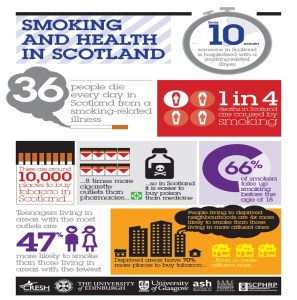
smoking_infographic2Today we’re launching our hot-off-the-press infographic about Smoking and Health in Scotland.  In collaboration with Action on Smoking and Health (ASH) Scotland we’ve created this summary of some of the key statistics on smoking and health in Scotland, featuring some headline results from our own research.  Please use and circulate widely! Continue reading Smoking and Health in Scotland: key stats

‘An environment where young people choose not to smoke’ is not one where tobacco products are sold on every street corner

By Niamh Shortt

Teenagers are more likely to smoke if they live in areas with the highest number of tobacco retailers. Our paper led by Niamh Shortt, published today in Tobacco Control, examined the relationship between tobacco outlet density and smoking habits of 13 and 15 year olds in Scotland.   Continue reading ‘An environment where young people choose not to smoke’ is not one where tobacco products are sold on every street corner

Will the new point of sale legislation in Scotland influence young people’s knowledge and attitudes of tobacco products?

By Jamie Pearce & Catherine Tisch

Smoking remains one of the most significant public health challenges in Scotland and is implicated in one in every five Scottish deaths.  Each year, around 15,000 young Scottish people start smoking and many go on to become regular smokers.  Since the introduction of the Tobacco Advertising and Promotion Act in 2005, most forms of tobacco advertising and sponsorship in the UK have been banned. One of the few ways the tobacco industry can legitimately promote their products (often by elaborate and prominent means) is via point of sale (POS) tobacco displays.  A recent systematic review showed that POS displays increased children’s susceptibility to smoking, experimentation and initiation into smoking. Continue reading Will the new point of sale legislation in Scotland influence young people’s knowledge and attitudes of tobacco products?

CRESH goes Stateside: International Medical Geography Symposium 2013

by Helena Tunstall, Catherine Tisch and Anna Kenyon

The 15th International Medical Geography Symposium, the biggest international academic health geography conference, took place July 7-12 this year, at Michigan State University (MSU) in East Lansing, USA. This conference is always a fun, friendly and inspirational meeting: a real CRESH highlight. This time we were represented by Helena Tunstall (presenting on ‘triple jeopardy’ in England and impacts of internal migration on health inequalities in UK), Anna Kenyon (presenting on walkability measures and walking outcomes in Scotland) and Catherine Tisch (presenting on tobacco environments and adolescent smoking behaviours in Scotland).  Abstracts for these talks can be found in the program, but watch this space for news of forthcoming publications on these topics. In this short blog post we note some thoughts arising from the conference.    Continue reading CRESH goes Stateside: International Medical Geography Symposium 2013

Alcohol and tobacco environments and adolescents’ health behaviours: future talk on CRESH research in Edinburgh

Title: Alcohol and tobacco environments in Scotland and their relationship with adolescent behaviour

Presenter: Dr Niamh Shortt
Date: Thursday 25th July 2013
Time: 11:00 am
Venue: Seminar Room, Scottish Collaboration for Public Health Research and Policy (SCPHRP), 20 West Richmond Street, Edinburgh, EH8 9DX (next door to the Mackenzie Medical Centre) Continue reading Alcohol and tobacco environments and adolescents’ health behaviours: future talk on CRESH research in Edinburgh

Tobacco and Alcohol Outlet Density and Adolescent Behaviours

Image courtesy of mack2happy / FreeDigitalPhotos.net
Image courtesy of mack2happy / FreeDigitalPhotos.net 

Tobacco and alcohol use pose significant global public health challenges and are major determinants of preventable morbidity and mortality.  Preventing tobacco and alcohol misuse in adolescence before habits are formed is an important policy goal. Previous research into the relationship between tobacco outlet density and smoking prevalence has resulted in mixed findings. Whilst some have reported increased smoking prevalence with a higher density of retail outlets around the home and school others have reported no significant associations.  For alcohol a positive association between drinking and alcohol outlet density has been reported around the home for adults, adolescents and around Universities for college students. Despite this there have been several calls for a policy response to address the tobacco retail environment, primarily by ‘restricting the number of retailers around child spaces’. We received seed funding from the Scottish Collaboration for Public Health Research and Policy (SCPHRP) to examine the density of tobacco and alcohol retail outlets in Scotland and their association with the prevalence of drinking and smoking behaviours in school aged children. Continue reading Tobacco and Alcohol Outlet Density and Adolescent Behaviours