
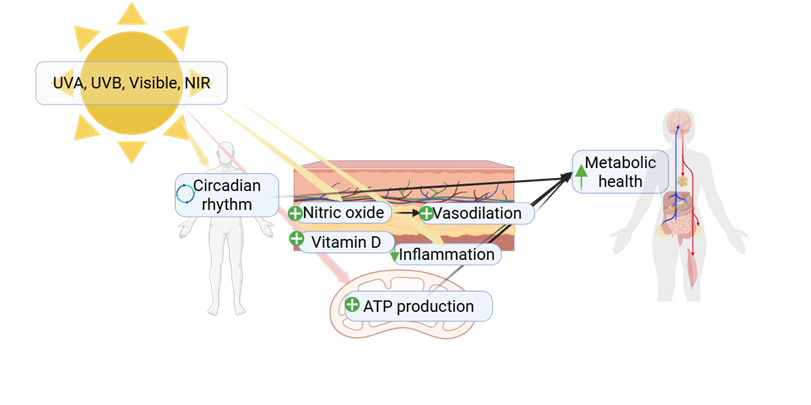
Created in BioRender. Stevenson, A. (2026) https://BioRender.com/ p885jgn
Our new study published in Scientific Reports suggests that sunlight exposure supports metabolic health, using data from over 400,000 UK Biobank participants. We find that short-term (day-to-day) sunlight exposure was associated with lower blood glucose levels and long-term sunlight exposure with lower likelihood of being diagnosed with type 2 diabetes in a dose-dependent manner, after extensive adjustment.
Why sunlight?
Poor diet, physical inactivity, and excess weight are well-known risk factors for type 2 diabetes; however, there is growing evidence that sunlight exposure may play a role in cardiometabolic health, through several plausible mechanisms.
For example, dermal ultraviolet exposure (UV) releases nitric oxide (NO) from skin stores within minutes (with levels remaining elevated for days), promoting vasodilation and suppressing inflammation. Red and near-infrared light, meanwhile, have been demonstrated to stimulate mitochondrial ATP production and suppress inflammation. Participants of a randomised trial who were exposed to 15 minutes of red light had 28% lower blood glucose levels after glucose intake compared to the placebo group.
Sunlight and metabolic health: what we did
We tested this using two complementary approaches in UK Biobank. First, we looked at whether people who happened to attend their health assessment on sunnier periods had lower blood glucose readings than those assessed on a less sunny period, adjusting for temperature. This was measured using satellite estimates of UVA radiation at each participant’s residential location, averaged separately over the two days up to and including the assessment and over the preceding seven days.
We compared people assessed on the same day of the week, month and year to rule out seasonal and weekly patterns. This design rests on two independent, exogenous sources of variation: assessment scheduling and day-to-day weather variation that determines sunlight levels. For a variable to confound our estimates, it would therefore need to be associated with both the scheduling decisions made, and the specific weather conditions on the day a participant happened to be scheduled, which is unlikely. This assumption was supported by strong balance in measured participant characteristics across sunny and less sunny days.
Second, we looked at longer-term sun exposure, using how often someone reported using a sunbed or solarium as a marker of habitual sun-seeking behaviour (non-user, occasional user, and frequency) and tracked participants from age 20 until either a diabetes diagnosis or the end of follow up, whichever came first. We adjusted for several clinical, socioeconomic and demographic variables.
What we found
In winter, people assessed on days with higher 2-day and 7-day average ambient sunlight exposure had modestly lower blood glucose levels. In spring, the same pattern held, but only for the 7-day average exposure.
The relationship was not linear. Predicted glucose levels dropped most steeply at low sunlight levels and then plateaued, meaning the benefit of extra sun was greatest from low baseline levels, with diminishing returns once exposure was already moderate. Because winter UVB in the UK isn’t strong enough to make vitamin D in skin, this points to sunlight acting through a route other than vitamin D.
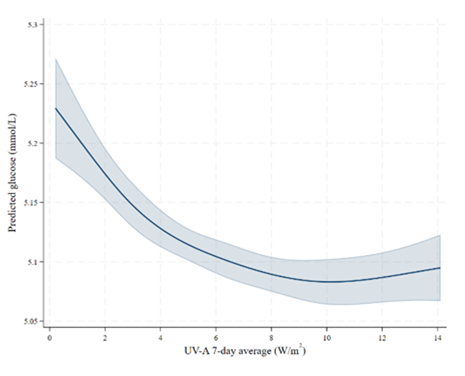
Associations between 7-day ambient ultraviolet A (UVA) radiation exposure and predicted glucose concentrations (mmol/L).
Longer-term sun exposure was associated with lower type 2 diabetes diagnosis. Compared with solarium or sunbed non-users, occasional users had a 14% lower hazard of type 2 diabetes diagnosis, and frequent users a 22% lower hazard, a dose-response pattern.
Differences in measured vitamin D were too large to be explained by solarium use alone, which was relatively modest in the cohort (an average of approximately once every two months among occasional users), consistent with solarium use tracking broader sun-seeking habits. Therefore, we regard this measure as a proxy for sun-seeking behaviour more generally.
What do these findings mean for public health?
The UK is a low sunlight country, where the UV index rarely exceeds 5 and winters are characterised by short, dark days. Our findings suggest that insufficient sunlight exposure may be an underrecognised but significant risk factor for impaired glucose regulation and type 2 diabetes.
Sunlight remains a known carcinogen, and photoprotection is still important. At the same time, in low sunlight countries, moderately higher exposure could reduce the risk of type 2 diabetes, a disease responsible for substantial morbidity and premature mortality, so even a modest effect at the population level could translate into a meaningful public health benefit.
We do not argue for solarium use as a way to reduce diabetes risk. Our solarium use variable likely reflects broader sun seeking behaviour rather than solarium exposure itself. Sources and doses of sunlight to achieve a safe, net health benefit remains to be established across different skin types.
A sensible public health angle may be to promote active outdoor living, which could improve metabolic health through both greater physical activity and greater sunlight exposure.
Stevenson, A.C., Weller, R.B., Lindqvist, P. et al. Sunlight exposure is associated with lower blood glucose levels and type 2 diabetes. Sci Rep (2026). https://doi.org/10.1038/s41598-026-66100-4
This work was supported by Health Data Research UK (grant ID: EDIN1), which is funded by the UK Medical Research Council, Engineering and Physical Sciences Research Council, Economic and Social Research Council, Department of Health and Social Care (England), Chief Scientist Office of the Scottish Government Health and Social Care Directorates, Health and Social Care Research and Development Division (Welsh Government), Public Health Agency (Northern Ireland), British Heart Foundation and the Wellcome Trust. This work was supported in part by UKRI’s Securing Better Health, Ageing and Wellbeing strategic theme.
PL was supported by Skarmans stiftelse, and the Swedish Research Council.
ACS was also supported by a Fonds de recherche du Québec – Santé Postdoctoral Award (FRQS; https://doi.org/10.69777/353073)

