Author: pearcej1

  • New research shows plausible mechanisms between sunlight exposure and metabolic health

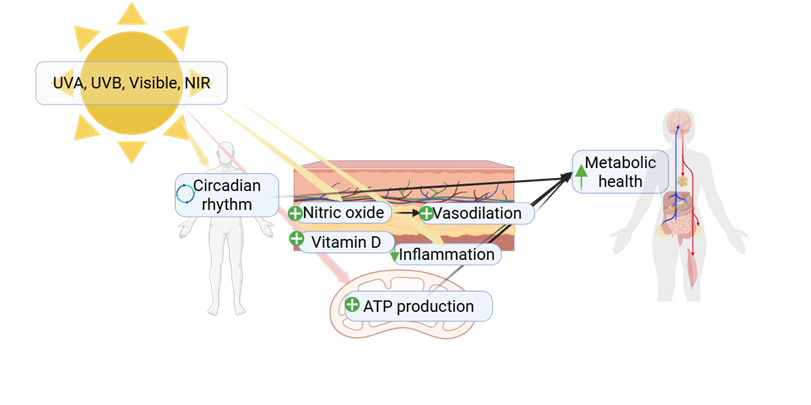
    Created in BioRender. Stevenson, A. (2026) https://BioRender.com/ p885jgn

    Our new study published in Scientific Reports suggests that sunlight exposure supports metabolic health, using data from over 400,000 UK Biobank participants. We find that short-term (day-to-day) sunlight exposure was associated with lower blood glucose levels and long-term sunlight exposure with lower likelihood of being diagnosed with type 2 diabetes in a dose-dependent manner, after extensive adjustment.

    Why sunlight?

    Poor diet, physical inactivity, and excess weight are well-known risk factors for type 2 diabetes; however, there is growing evidence that sunlight exposure may play a role in cardiometabolic health, through several plausible mechanisms.

    For example, dermal ultraviolet exposure (UV) releases nitric oxide (NO) from skin stores within minutes (with levels remaining elevated for days), promoting vasodilation and suppressing inflammation. Red and near-infrared light, meanwhile, have been demonstrated to stimulate mitochondrial ATP production and suppress inflammation. Participants of a randomised trial who were exposed to 15 minutes of red light had 28% lower blood glucose levels after glucose intake compared to the placebo group.

    Sunlight and metabolic health: what we did

    We tested this using two complementary approaches in UK Biobank. First, we looked at whether people who happened to attend their health assessment on sunnier periods had lower blood glucose readings than those assessed on a less sunny period, adjusting for temperature. This was measured using satellite estimates of UVA radiation at each participant’s residential location, averaged separately over the two days up to and including the assessment and over the preceding seven days.

    We compared people assessed on the same day of the week, month and year to rule out seasonal and weekly patterns. This design rests on two independent, exogenous sources of variation: assessment scheduling and day-to-day weather variation that determines sunlight levels. For a variable to confound our estimates, it would therefore need to be associated with both the scheduling decisions made, and the specific weather conditions on the day a participant happened to be scheduled, which is unlikely. This assumption was supported by strong balance in measured participant characteristics across sunny and less sunny days.

    Second, we looked at longer-term sun exposure, using how often someone reported using a sunbed or solarium as a marker of habitual sun-seeking behaviour (non-user, occasional user, and frequency) and tracked participants from age 20 until either a diabetes diagnosis or the end of follow up, whichever came first. We adjusted for several clinical, socioeconomic and demographic variables.

    What we found

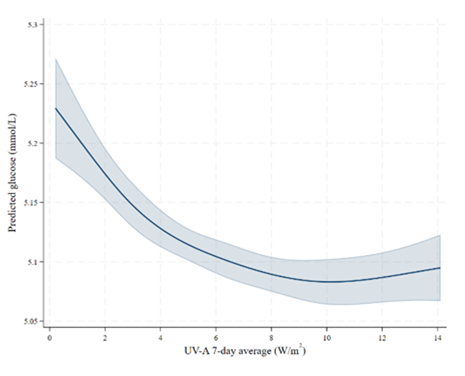
    In winter, people assessed on days with higher 2-day and 7-day average ambient sunlight exposure had modestly lower blood glucose levels. In spring, the same pattern held, but only for the 7-day average exposure.

    The relationship was not linear. Predicted glucose levels dropped most steeply at low sunlight levels and then plateaued, meaning the benefit of extra sun was greatest from low baseline levels, with diminishing returns once exposure was already moderate. Because winter UVB in the UK isn’t strong enough to make vitamin D in skin, this points to sunlight acting through a route other than vitamin D.

    Associations between 7-day ambient ultraviolet A (UVA) radiation exposure and predicted glucose concentrations (mmol/L).

    Longer-term sun exposure was associated with lower type 2 diabetes diagnosis. Compared with solarium or sunbed non-users, occasional users had a 14% lower hazard of type 2 diabetes diagnosis, and frequent users a 22% lower hazard, a dose-response pattern.

    Differences in measured vitamin D were too large to be explained by solarium use alone, which was relatively modest in the cohort (an average of approximately once every two months among occasional users), consistent with solarium use tracking broader sun-seeking habits. Therefore, we regard this measure as a proxy for sun-seeking behaviour more generally.

    What do these findings mean for public health?

    The UK is a low sunlight country, where the UV index rarely exceeds 5 and winters are characterised by short, dark days. Our findings suggest that insufficient sunlight exposure may be an underrecognised but significant risk factor for impaired glucose regulation and type 2 diabetes.

    Sunlight remains a known carcinogen, and photoprotection is still important. At the same time, in low sunlight countries, moderately higher exposure could reduce the risk of type 2 diabetes, a disease responsible for substantial morbidity and premature mortality, so even a modest effect at the population level could translate into a meaningful public health benefit.

    We do not argue for solarium use as a way to reduce diabetes risk. Our solarium use variable likely reflects broader sun seeking behaviour rather than solarium exposure itself. Sources and doses of sunlight to achieve a safe, net health benefit remains to be established across different skin types.

    A sensible public health angle may be to promote active outdoor living, which could improve metabolic health through both greater physical activity and greater sunlight exposure.

    Stevenson, A.C., Weller, R.B., Lindqvist, P. et al. Sunlight exposure is associated with lower blood glucose levels and type 2 diabetes. Sci Rep (2026). https://doi.org/10.1038/s41598-026-66100-4

    This work was supported by Health Data Research UK (grant ID: EDIN1), which is funded by the UK Medical Research Council, Engineering and Physical Sciences Research Council, Economic and Social Research Council, Department of Health and Social Care (England), Chief Scientist Office of the Scottish Government Health and Social Care Directorates, Health and Social Care Research and Development Division (Welsh Government), Public Health Agency (Northern Ireland), British Heart Foundation and the Wellcome Trust. This work was supported in part by UKRI’s Securing Better Health, Ageing and Wellbeing strategic theme.

    PL was supported by Skarmans stiftelse, and the Swedish Research Council.

    ACS was also supported by a Fonds de recherche du Québec – Santé Postdoctoral Award (FRQS; https://doi.org/10.69777/353073)

  • The Uneven Rise of No/Lo Alcohol Drinks in Great Britain: A Look at Local Shops

    New work from the CRESH team has found a significant increase in the availability and sales of no and low alcohol (No/Lo) beverages in convenience stores across Great Britain. At the same time, the growth in availability and sales of these products was disproportionately higher in less deprived neighbourhoods of the country. These findings have some important implications for public health, particularly given the mixed evidence on whether No/Lo beverages act as substitutes for standard alcohol products (potentially reducing harm) or as supplements (potentially increasing overall consumption).

    The Growth of No/Lo Products: a case study in Great Britain

    No/Lo beverages are alcohol-mimicking drinks that contain no or low amounts of alcohol, and their popularity has grown rapidly across high-income countries reflecting changes in consumer preferences and drinking behaviours. Our recent CRESH study, published, with colleagues in Sheffield, in Addiction, examined how the availability and sales of No/Lo products have evolved in local stores across Great Britain between 2018 and 2022. We found that in 2018, only 34% of small retailers sold No/Lo products, rising to 68% by 2022.

    However, the availability and sales of No/Lo beverages differed across neighborhoods with varying levels of deprivation. By 2022, retailers in more affluent neighbourhoods recorded 33% higher sales of No/Lo products and offered more than twice as many products as those in the most deprived areas. Compared with 2018, we identified that these inequalities in availability and sales between the most and least deprived neighbourhoods have widened over time.

    This study draws on data from more than 11 million alcohol transactions from 1,432 retailers operating between 2018 and 2022 across Great Britain. This comprehensive dataset is particularly valuable, as such data are rarely accessible due to high costs and commercial sensitivity. Previous research has largely relied on survey data, which can be affected by recall and social desirability bias and do not capture geographic variation in availability and purchasing patterns. In addition, most existing studies have focused on sales in bars and pubs, whereas this study captures purchasing in retail settings. This is particularly relevant in a context where alcohol consumption at home is increasing, and local shops enable quick and often spontaneous purchases.

    What do these findings mean for public health?

    These findings align with previous research showing that individuals with higher socioeconomic status are more likely to consume No/Lo products, often linked to greater health awareness and lifestyle changes, particularly since COVID-19. These differences in preferences and purchasing power are likely reflected in spatial patterns of availability and sales, with higher uptake in more affluent areas. This can be also explained by the influence of large transnational alcohol companies. Product availability, range, and marketing are shaped by market forces that tend to favour more commercially attractive locations, reinforcing geographic inequalities.

    The public health implications of this uneven distribution remain uncertain. Evidence is mixed on whether No/Lo products reduce overall alcohol consumption (as substitutes) or increase it (as complements). If they do contribute to harm reduction, our findings suggest that these benefits are currently concentrated in more affluent communities—raising concerns about widening inequalities, given that alcohol-related harm is higher in more disadvantaged groups.

    This points to the need to consider equity in how No/Lo products are distributed and promoted. Potential policy responses could include incentives for retailers in more deprived areas to stock No/Lo options, alongside awareness campaigns tailored to different social groups. These approaches could complement existing measures such as alcohol taxation and minimum unit pricing (MUP), which may also make No/Lo products relatively cheaper and therefore more attractive alternatives.

    However, framing No/Lo products as a public health solution requires caution. Increased availability may contribute to the normalisation of alcohol consumption. Major alcohol companies are increasingly promoting No/Lo products, potentially using them to strengthen brand visibility. Such practices may normalise drinking behaviours and indirectly reinforce demand for higher-strength products, thereby undermining anticipated public health benefits. There are also concerns about a possible “gateway” effect, particularly among young people, who can purchase zero-alcohol products and may not clearly distinguish them from alcoholic beverages. This raises questions about the role of No/Lo products in shaping drinking norms from an early age.

    An uneven rise—and what comes next

    The study findings suggest that public health responses to the expansion of No/Lo products should adopt a geographical lens, accounting for regional contexts and inequalities. Any potential benefits or harms are unlikely to be evenly distributed under current market conditions. Further research is needed to better understand whether No/Lo products act as substitutes for or supplements to standard alcohol, particularly by examining: (i) who is being reached; (ii) which populations lack access; and (iii) how retail availability shapes consumption opportunities across different areas. Until stronger evidence is available on harm-reduction effects, consumption patterns, and potential unintended consequences, policies aimed at promoting No/Lo availability should be approached with caution.

    This is particularly relevant in a context where the UK Government has committed to delivering a significant increase in the availability of alcohol-free and low-alcohol drinks.

    Despite this, No/Lo beverages accounted for just 0.25% of total alcohol sales in local shops I 2022 in Great Britain, suggesting that their current impact—whether as substitutes or supplements—is likely to be limited. However, further investigation is warranted.

    This work was funded through the SPECTRUM consortium.

    Roberto Valiente Borox

  • Recession, austerity and health

    We recently developed a project summary for an ESRC-funded study looking at the impact of the financial crisis and subsequent austerity measures on mental health and wellbeing in the UK. The summary for the CRESH project (full title: Recession, austerity and health: changing area socio-economic conditions and their relationship to individual health and wellbeing outcomes in Scotland) includes the key findings, links to papers published, details of some of the dissemination activities, and other useful resources. You can read more in the pdf below:

  • The declining importance of tobacco sales to convenience stores in Britain

    Tobacco products are becoming less important to the business models of convenience stores across Britain. This is the finding of our new study of the products sold in convenience stores over a 3 year period across England, Scotland and Wales prior to the start of the Covid pandemic. 

    Looking at the sales of tobacco and other products sold alongside tobacco is important because it tells us about how much profit is made from tobacco by smaller retailers but also about the role of tobacco in generating greater ‘footfall’ for these smaller retailers. It is argued that footfall products, such as milk or bread, bring customers into the store and lead to wider expenditure on other (non-footfall) items.  The tobacco industry has long argued that tobacco is vital for increasing customer footfall and therefore tobacco products help drive the sales of other (potentially more profitable) items that retailers stock. Our new results recently published in the journal Tobacco Control suggest the footfall argument made by the tobacco industry does not hold-up to scrutiny.

    How did we go about our research? We looked at this issue by examining the electronic till receipts of all items purchased in almost 1300 retailers across the country during 4 corresponding weeks in 2016 and 2019. We found that the number of shopping baskets containing tobacco fell by nearly half (47%) over these 3 years. When we compared tobacco to other commonly purchased products (such as milk, bread, newspapers and alcohol) we found that the decline in sales was much higher for tobacco.

    We also discovered that the price of tobacco products rose significantly over this time period yet at the same time the proportion of total store turnover accounted for by shoppers who included a tobacco product in their basket fell. In 2016, 11 per cent of transactions involved only tobacco, but this fell to 6 per cent in 2019. The proportion of sales containing a mix of tobacco products and other items also declined, falling from 14 per cent to 9 per cent.  It was also evident that as the frequency of tobacco transactions declined so the financial value of non-tobacco items bought alongside tobacco also reduced.

    When we examined geographical differences in the sales data, we found that retailers’ declining reliance on tobacco sales was seen across the country. Tobacco product sales, and their contribution towards weekly turnover, were higher in shops in urban, more economically deprived areas compared with rural stores and those in affluent areas. However, these stores saw the greatest reductions over time, narrowing the differences between areas.

    Why does all this matter? The governments in England, Scotland and Wales all have ambitious targets to eliminate smoking over the next decade. For example, in Scotland the Scottish Government is committed to reducing the proportion of the population who smoke to 5% by 2034. Similar targets are in place in England and Wales. Yet meeting these goals will require a wide range of policies including reducing the availability of tobacco products. In Scotland, for example, tobacco remains highly available with around 10,000 retailers selling tobacco which means it can be purchased on most street corners. A key obstacle to reducing the number of places where tobacco can be purchased has been concerns about how this will affect smaller businesses that may be particularly dependent on selling tobacco, and also that selling tobacco helps to drive the sales of other (more profitable) products. Our findings counter this claim and show that tobacco is becoming less important to smaller retailers.

    We, therefore, encourage policymakers in the UK to follow the lead of the New Zealand government who have an ambitious plan to greatly reduce the number of tobacco retailers, as well as the recommendations of The Khan review: making smoking obsolete report commissioned by the UK Government to develop new policies in England that will lessen the availability of tobacco in our local communities. Policy approaches should include help for businesses to diversify away from tobacco, including support for smaller stores to focus on more health enabling and more profitable products. This would be a crucial step towards reducing the number of people who smoke, and eliminating a product that is responsible for the deaths of 78,000 people in the UK each year.

    Tunstall H, Shortt N, Kong A, Pearce J, 2022. Is tobacco a driver of footfall amongst small retailers? A geographical analysis of tobacco purchasing using electronic point-of-sale data. Tobacco Control. In Press.

  • New job at CRESH: Postdoctoral Researcher, Environment and Health

    New job at CRESH: Postdoctoral Researcher, Environment and Health

    This is a full time (35 hours per week), fixed term post available for 3 years.

    The salary for this role is £33,797 – £40,322 per annum.

    We are seeking to appoint a Postdoctoral Researcher in the field of ‘Environment and Health  for a period of 3 years to contribute a UK Prevention Research Partnership (UKPRP) Consortium – SPECTRUM (Shaping Public hEalth poliCies To Reduce ineqUalities and harm) www.ed.ac.uk/spectrum. SPECTRUM has an ambitious programme of research, knowledge exchange and public engagement focusing on the commercial determinants of health relating to tobacco, alcohol and food. In this role you will work under the supervision and mentorship of Professor Jamie Pearce and Professor Niamh Shortt.

    The successful candidate will play a lead role in a programme of work aiming to identify how the local environment can be shaped to change behaviour, prevent harm and reduce inequalities. The aim is to examine the intended and unintended impacts of (and interventions in) the local commercial environment on the consumption of unhealthy commodities. The focus of this role will be to conduct spatial and quantitative analyses, contribute to final publications and help to accelerate the impact of the research.

    Informal enquiries to Prof Jamie Pearce (jamie.pearce@ed.ac.uk), Prof Niamh Shortt (niamh.shortt@ed.ac.uk)

    For more details and how to apply click here.

  • Job opportunity: urban forestry and human wellbeing

    We are currently looking to recruit a postdoctoral researcher to contribute to an ESRC funded study concerned with the role of urban forestry in understanding human wellbeing, particularly amongst children.

    https://elxw.fa.em3.oraclecloud.com/hcmUI/CandidateExperience/en/sites/CX_1001/job/339

    Fixed Term, 19 months, Full Time (35 hours per week)

    1/04/2021 – 30/10/2022 (dates negotiable)

    Closing date: 12th February 2021

    The researcher will be appointed based on the statistical and geospatial skills that this study will require. They will be responsible (under supervision of the Investigator team) for preparing and quality checking variables to measure woodland and forest exposure over time. They will also be responsible for identifying relevant data from the Scottish Longitudinal Study (SLS) and associated linked health datasets to provide longitudinal data for SLS members and their children over the period of the WIAT programme, and for undertaking appropriate statistical analyses.

    The post involves working in the context of two world-leading centres of research, exploring links between environment and health. The post is based in OPENspace research centre, which focuses on inclusive access to outdoor environments and their associated benefits for wellbeing and quality of life. The study will involve close collaboration with the Centre for Research on Environment, Society and Health (CRESH), a virtual centre joining scientists from the Universities of Edinburgh and Glasgow, focused on exploring how physical and social environments can influence population health, for better and for worse.

    The successful candidate will play a lead role in utilising environmental datasets provided by Scottish Forestry (SF) to extract and process relevant geographical data that records details of SF’s Woods In and Around Towns (WIAT) programme from 2005-2015, link them to individual level census, health and child development data, and use appropriate analyses to provide better evidence on the contribution urban forestry can make to human wellbeing. The post-holder will contribute to final publications and support the impact activities relating to the research.

    The study and work of the post-holder will be overseen by Professor Catharine Ward Thompson, as Principal Investigator, with experience of multi-disciplinary research and engagement with research partners and end-users. Co-supervision of the post-holder by Co-Investigators (Co-Is) Professor Jamie Pearce and Dr Tom Clemens (CRESH, University of Edinburgh) will assist with details of data identification, manipulation and longitudinal analysis. The post-holder will also collaborate with Co-I Professor Richard Mitchell (MRC/CSO Social & Public Health Sciences Unit/CRESH, University of Glasgow) on operationalisation, linkage and analysis of environmental datasets in relation to health outcomes.

     Other key contacts will include liaison with staff in Scottish Forestry, Forest Research, Public Health Scotland and other stakeholders as necessary to undertake the project, and to share and disseminate its results.

    For further details please contact Professor Catharine Ward Thompson c.ward-thompson@ed.ac.uk

  • Job Opportunity at CRESH

    We are looking to appoint a Postdoctoral Researcher in the field of ‘Environment and Health for a period of 4 years to contribute a UK Prevention Research Partnership (UKPRP) Consortium – SPECTRUM (Shaping Public hEalth poliCies To Reduce ineqUalities and harm) https://www.ed.ac.uk/spectrum.   SPECTRUM has an ambitious programme of research, knowledge exchange and public engagement focusing on the commercial determinants of health relating to tobacco, alcohol and food.

    The successful candidate will play a lead role in a programme of work aiming to identify how the local environment can be shaped to change behaviour, prevent harm and reduce inequalities. The aim is to examine the intended and unintended impacts of (and interventions in) the local commercial environment on the consumption of unhealthy commodities. The focus of this role will be to conduct spatial and quantitative analyses, contribute to final publications and help to accelerate the impact of the research.

    For further details – including how to apply – can be found here.

  • Come and join the CRESH team!

    We are currently recruiting a Postdoctoral Researcher in the field of ‘Environment and Health’ for 20 months to contribute to an interdisciplinary ESRC funded study entitled ‘Lifecourse of Place: how environments throughout life can support healthy ageing’. In this role, you will work under the supervision of Professor Jamie Pearce and Professor Niamh Shortt (School of GeoSciences), as well as collaborate with colleagues in Psychology in the School of Philosophy, Psychology and Language Sciences (Professor Ian Deary and Dr Simon Cox) and Edinburgh College of Art (Professor Catharine Ward Thompson).

    The successful candidate will play a lead role in utilising environmental datasets and the Lothian Birth Cohort 1936 to explore how different environments over the lifecourse influence healthy ageing. The focus of this role will be to conduct longitudinal data analysis, contribute to final publications and help to accelerate the impact of the research. You will be a self-motivated individual with the ability to take responsibility for key components of the research plan. There are opportunities to shape the details of the research agenda.

    Based at the School of GeoSciences, University of Edinburgh you will join the Centre for Research on Environment, Society and Health (CRESH).

    For further details click here.

    Informal enquiries to Prof Jamie Pearce (jamie.pearce@ed.ac.uk), Prof Niamh Shortt (niamh.shortt@ed.ac.uk)

  • New journal: Wellbeing, Space & Society

    CRESH co-Director Jamie Pearce who is co-editing a new journal focused on the role of place in understanding human health and wellbeing along with Susan Elliott who is a Professor at the University of Waterloo, Canada.The journal, named Wellbeing, Space & Society, is an interdisciplinary journal concerned with the difference that space, place and location make to wellbeing. It welcomes submissions that are theoretically informed, empirically supported, of interest to an international readership, address a problem of interest to society, and illustrate the links (potential or theorized) between (aspects of) society and space and wellbeing. We publish papers from a range of social science disciplines – geography, sociology, social psychology, social epidemiology, economics, anthropology, political science, amongst others.

    The editors are particularly interested in the policy implications of the research, including work informed by policy analysis. Methodological plurality and innovation are encouraged; interpretation of wellbeing in this context may be subjective or objective, eudonic or hedonic, and may also be at the individual and/or community levels. But they are particularly interested in the wellbeing of places – how is that conceptualized, theorized, operationalised and translated?

    For more information please contact Jamie Pearce